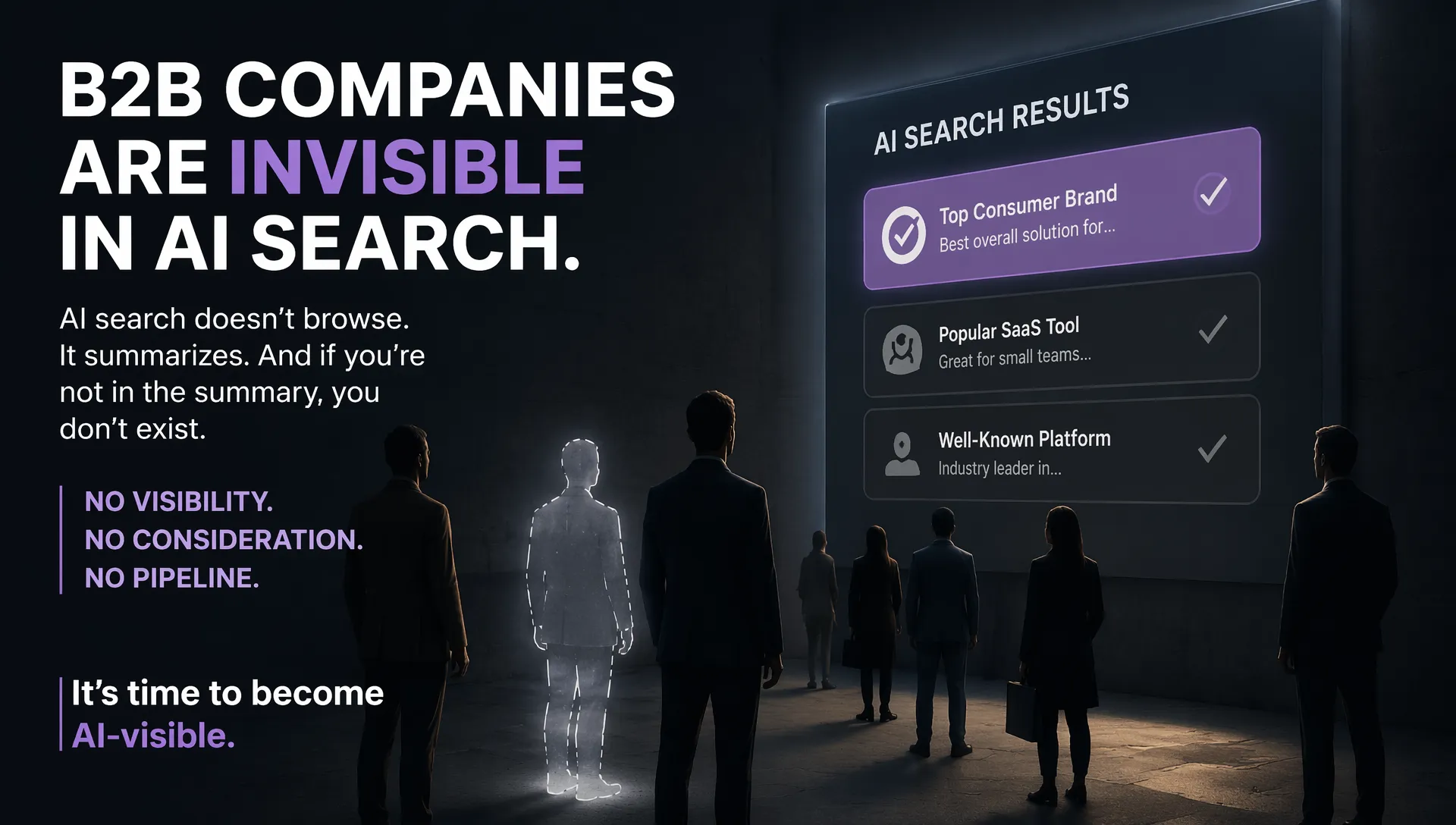
Why Singapore B2B companies are invisible in AI search — and why most don't know it yet
B2B buyers in Singapore research software in ChatGPT and Perplexity. Most local SaaS companies have no AI visibility strategy yet.
Something shifted in B2B software buying in Singapore over the past eighteen months, and most marketing teams missed it.
The shift is not another channel to add to the stack. It is a change in where purchase research begins. When a CFO asks which cross-border payment platform handles ASEAN supplier payouts, or an HR director asks which payroll software Singapore SMEs actually use, the answer increasingly comes from ChatGPT, Perplexity, or Google AI Overview — not from a Google search results page they click through one link at a time.
That sounds incremental until you test it against your own company name.
The invisible gap
We see this pattern when auditing Singapore SaaS companies — fintech, HR tech, logistics, spend management, proptech. Marketing teams report strong organic traffic, credible case studies, active LinkedIn presence, and sometimes page-one Google rankings for category terms. And yet, when you run the prompts their buyers actually use in AI engines, their company is absent.
Not ranked poorly. Absent.
The AI answer names a handful of vendors — often the same Singapore and global brands that appear in comparison articles, G2 profiles, and years of third-party coverage — and a credible local company serving that market every day does not appear at all.
This is the visibility gap. It is different from an SEO ranking problem. Your brand can surface in one part of Google while never being cited when a buyer asks ChatGPT or Perplexity the question that matters.
We tested this: Swingvy and payroll software
To make the gap concrete, we ran a single-engine audit on Swingvy, a Singapore HR and payroll SaaS company, on 26 June 2026. We used two tests:
- Google (Singapore): search
payroll software singapore sme - Buyer prompt (same wording across ChatGPT, Perplexity, and Claude):
I’m an HR director in Singapore. Which payroll software platforms should I shortlist for CPF, SDL, and IRAS compliance?
Each engine was queried once in a standard browser session. This is a snapshot, not a multi-week tracker — but it is enough to show how fragmented visibility already is.
What we found
| Surface | Swingvy mentioned? | Who appeared instead |
|---|---|---|
| Google AI Overview | Yes | QuickHR, brioHR, Talenox, SMEPayroll, Singroll, and others |
| Google page 1 organic (blue links) | No | SMEPayroll, Singroll, Xero, Info-Tech, QuickHR, Wise, BIPO, and others |
| ChatGPT | No | Talenox, PeopleCentral, JustLogin, QuickHR, Info-Tech HRMS, Employment Hero |
| Perplexity | No | PeopleCentral, Talenox, Payboy |
| Claude | No | Talenox, JustLogin, QuickHR, Info-Tech HRMS, Omni HR, Frontier eHR |
Three takeaways:
Google is not one result. Swingvy appeared inside Google’s AI Overview summary — alongside Talenox, QuickHR, and Singroll — but not in the page 1 organic listings on the same screen. AI Overview visibility and blue-link SEO are already diverging.
Conversational AI shortlists did not include Swingvy. All three engines returned payroll vendors. Most were Singapore-local (Talenox, PeopleCentral, JustLogin). None named Swingvy on the buyer prompt above.
Sources explain the names you do get. Perplexity cited IRAS payroll guidance, Singapore HR listicles (Omni HR, SnapHRM, BrioHR), and vendor pages for Talenox and PeopleCentral. ChatGPT leaned on the same vendor homepages. The engines are not reading your product page — they are synthesising from whichever third-party sources already mention a brand.
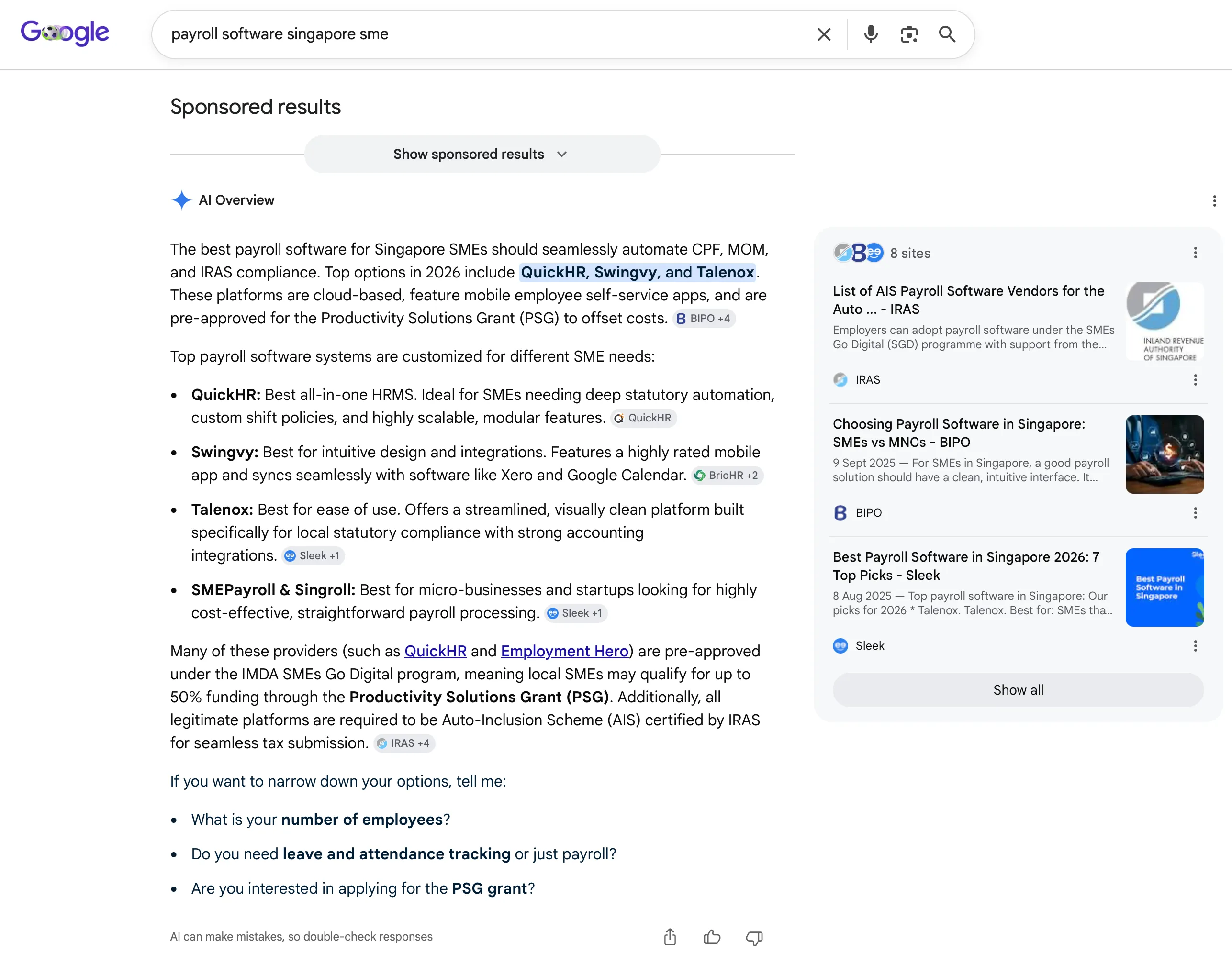
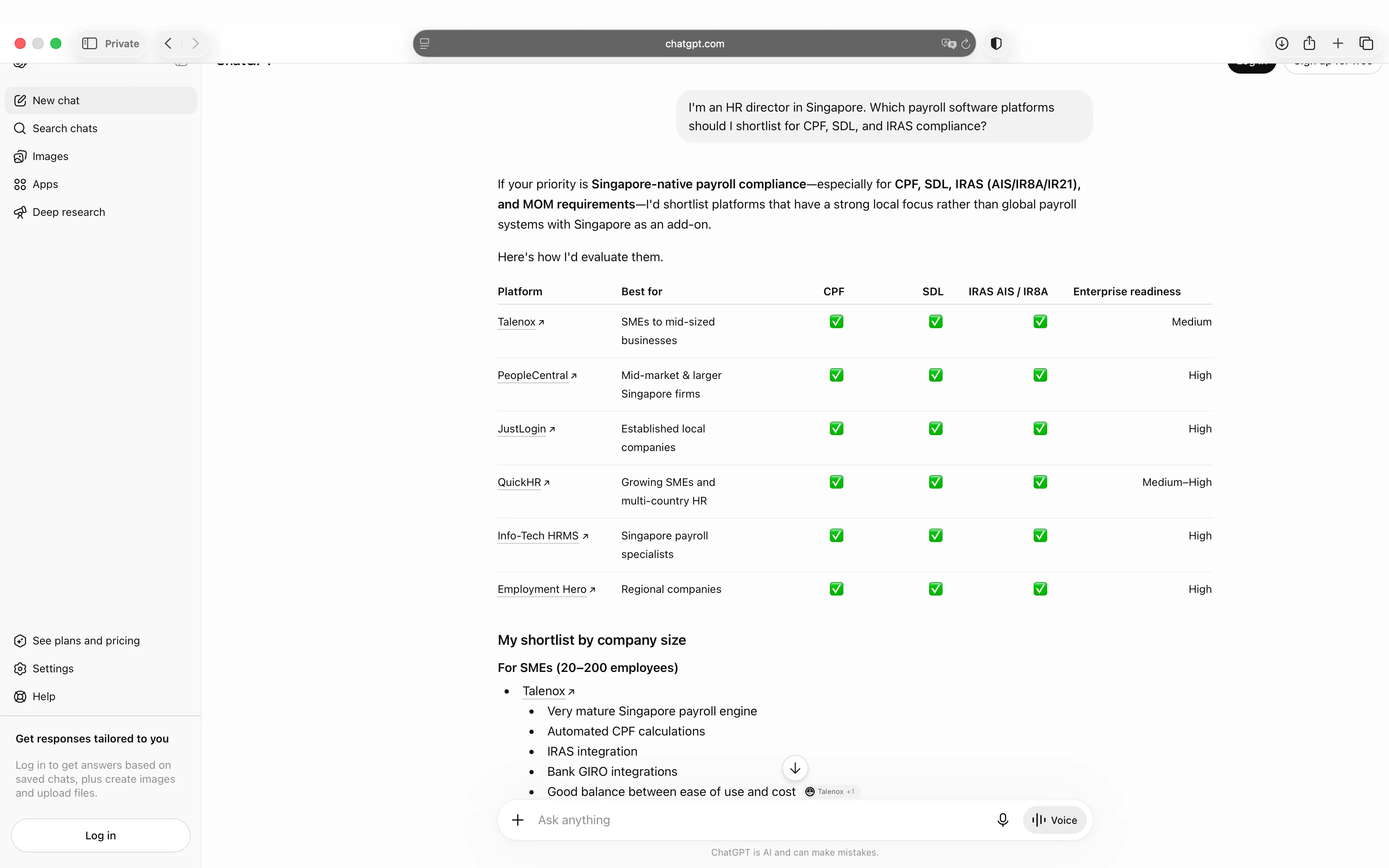
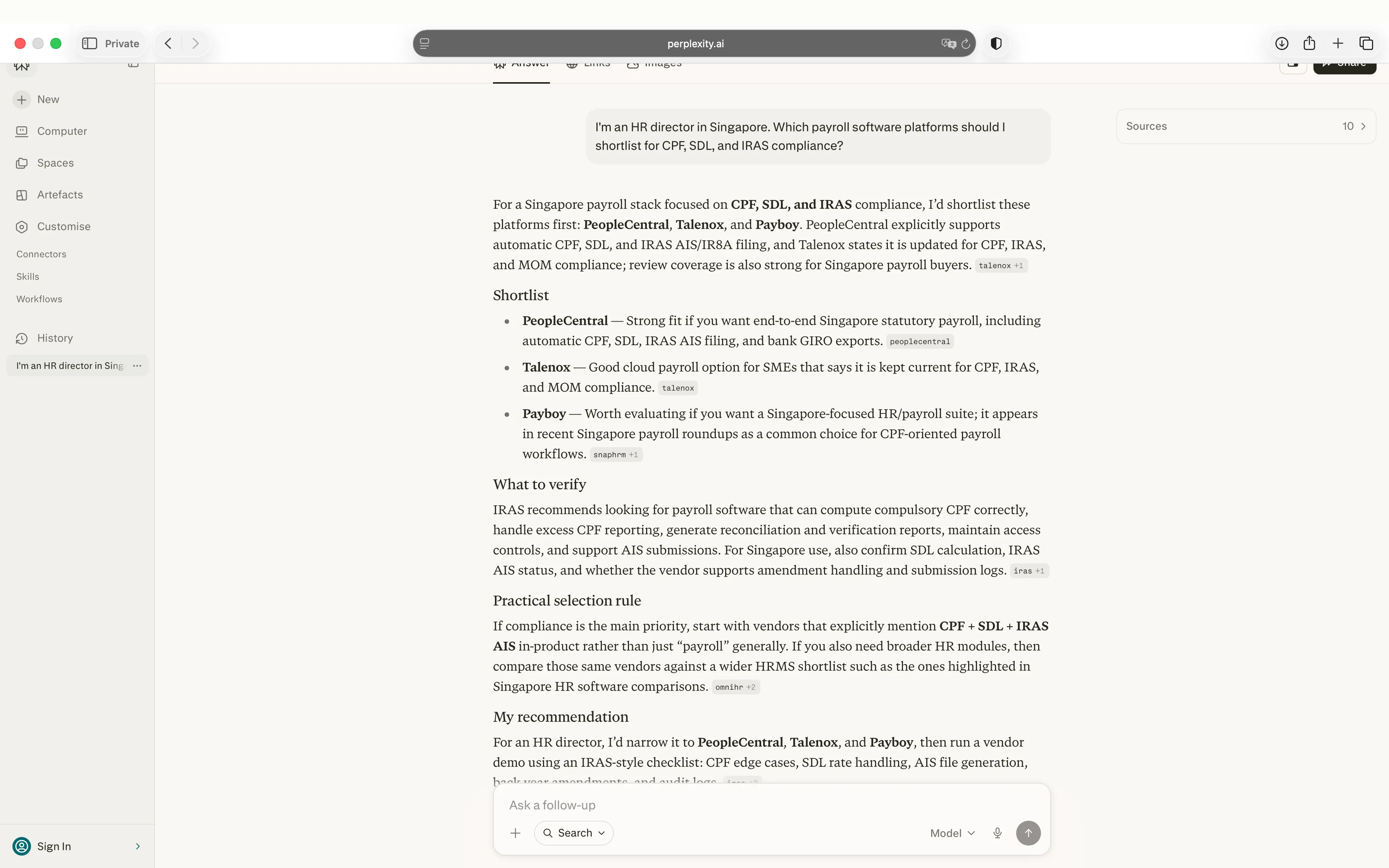
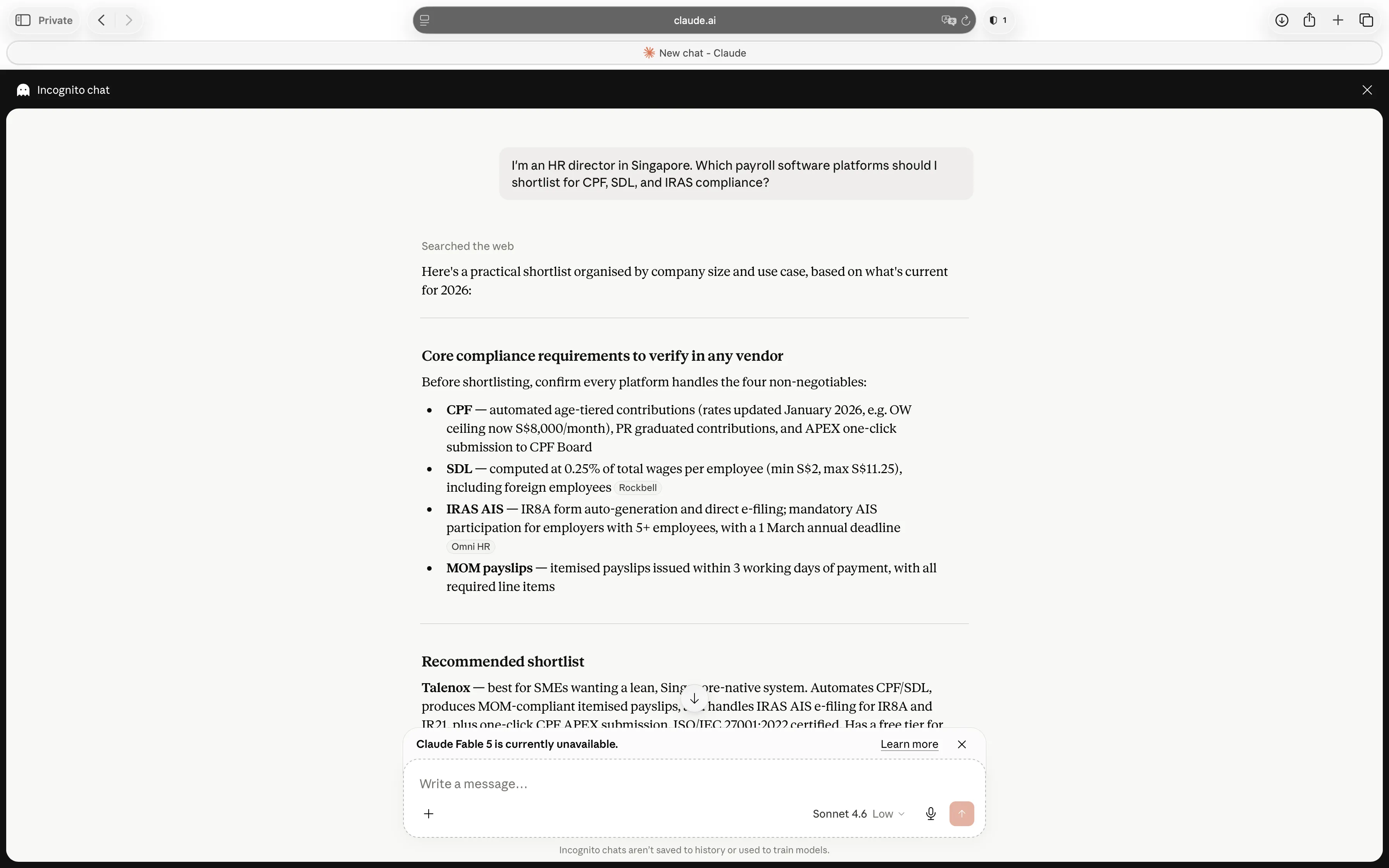
This is what invisibility looks like in practice: not zero presence everywhere, but no control over which surface recommends you — and conversational AI, where buyer research is moving fastest, forming a shortlist without you on it.
Why most companies do not know yet
Three reasons explain the blind spot.
First, the metrics do not show it. Marketing dashboards track website sessions, MQLs, and keyword rankings. None of them show whether ChatGPT recommended you when a prospect researched your category on Tuesday afternoon. The data exists only if you go looking for it.
Second, the buyer does not tell you. When a prospect arrives with a shortlist already formed, they rarely mention that Perplexity built it. They ask for a demo of the two vendors they already know. You win or lose before the first conversation — and you never learn why you were not on the list.
Third, the playbook is undefined. SEO has twenty years of established practice. AI search visibility — sometimes called AEO or generative engine optimisation — has no standard methodology, no agency category, and almost no specialists in Southeast Asia. Marketing teams assume their SEO work covers it. It does not.
What AI engines actually cite
AI engines do not mirror Google’s ranking order. They synthesise answers from sources they trust for factual, comparative questions: established publishers, structured comparison content, official documentation, government references, and third-party review platforms with deep category coverage.
For Singapore B2B categories, the sources that get cited most often are not vendor homepages. They are explainer articles, “best of” comparisons, and neutral guides that name multiple products with context. If no authoritative source mentions your company in a format AI engines can parse, you will not appear — regardless of how good your product is.
In the Swingvy test, Perplexity’s citations included iras.gov.sg, omnihr.co, snaphrm.com, and briohr.com — not swingvy.com. That is the mechanism behind the gap.
This is why a Series B HR tech company with hundreds of Singapore customers can lose a buyer to a competitor that invested in one well-structured comparison article targeting the exact prompt the buyer typed.
Why Southeast Asia is not exempt
There is a assumption that AI search visibility is a US or European problem — that buyers in Singapore still research the traditional way. That assumption is already wrong for software categories.
Singapore B2B buyers are early adopters. English-language AI tools work well for the prompts they use. The categories where AI research is most advanced — payroll, payments, corporate cards, logistics software — are exactly the categories where Singapore has strong local vendors competing against global incumbents.
The companies most exposed are those with strong local traction but weak third-party authority signals: no comparison content, no structured FAQ schema, no citations in the sources AI engines already trust.
What comes next
The companies that act first in Southeast Asia will compound an advantage that is difficult to reverse. AI engines learn from what already gets cited. If your competitor appears in category answers today, their authority grows with every prompt. If you are absent, the gap widens weekly.
The starting point is not a content sprint or a schema project. It is an audit: run the prompts your buyers use, record what AI engines return, identify who appears instead of you, and understand why. That baseline turns an invisible problem into a measurable one — and a measurable problem into a strategy.
Most Singapore B2B companies do not have that baseline yet. That is the gap we are here to close.
If you want to see where your company stands today, request a free AI visibility audit.
Sources and methodology
Primary evidence is a Citable visibility audit of Swingvy (Singapore HR and payroll SaaS), 26 June 2026. Each engine was queried once in a standard browser session, Singapore region — mirroring how a buyer would research, not a multi-run average.
Citable audit data (primary)
- Citable visibility audit of Swingvy — prompts, screenshots, and raw outputs documented in this article
Observed in AI engine responses
Listed for transparency; Citable does not endorse third-party content.
- IRAS — Types of controls for payroll software (retrieved 26 June 2026)
- Talenox — Payroll (Singapore) (retrieved 26 June 2026)
- PeopleCentral — Payroll (Singapore) (retrieved 26 June 2026)
- SnapHRM — Best HR software Singapore (retrieved 26 June 2026)
- BrioHR — Best payroll software Singapore (retrieved 26 June 2026)
- Omni HR — Best HR software Singapore (retrieved 26 June 2026)
- Omni HR — Payroll software Singapore (retrieved 26 June 2026)
- Rockbell — Singapore payroll compliance for SMEs (2026) (retrieved 26 June 2026)
- Bolto — Payroll software Singapore guide (retrieved 26 June 2026)
- QuickHR — Payroll features (Singapore) (retrieved 26 June 2026)
- Info-Tech — Payroll software (Singapore) (retrieved 26 June 2026)
- Frontier eHR — Payroll software Singapore (2026) (retrieved 26 June 2026)
Frequently asked questions
- Why are Singapore B2B companies invisible in AI search?
- Most B2B SaaS companies in Singapore still optimise for Google rankings alone. AI engines like ChatGPT and Perplexity synthesise answers from a different set of sources — comparison articles, review platforms, and third-party explainers — which means a credible local vendor can be absent from conversational AI shortlists even when it appears elsewhere in Google.
- What is the difference between SEO and AI search visibility?
- SEO focuses on ranking your website in Google's blue links. AI search visibility is about being cited inside generated answers — when a buyer asks ChatGPT or Perplexity which payroll software to use in Singapore, your brand either appears as a recommended option or it does not. These are related but distinct outcomes.
- Which AI engines matter most for B2B buyers in Singapore?
- ChatGPT, Perplexity, and Google AI Overview are the three engines where B2B software research is shifting fastest in Singapore. Buyers use them for category discovery, shortlisting, and vendor comparison — often before they visit a vendor website directly.
- How quickly are Southeast Asia B2B buyers adopting AI search?
- Adoption in Singapore is ahead of the regional average. Marketing teams report buyers arriving with AI-generated shortlists already formed. Companies that wait for AI search to mature before acting are effectively ceding category conversations to competitors and third-party publishers.
- What should a Singapore B2B company do first?
- Run a structured visibility audit — test the exact prompts your buyers type into ChatGPT and Perplexity, record who gets cited instead of you, and identify the content gaps. That baseline tells you whether the problem is discoverability, authority, or both.
- Is this only a problem for small B2B companies?
- No. Well-funded Series A to Series C SaaS companies in Singapore are frequently absent from AI-generated answers in their own categories — despite strong Google rankings and active content marketing. The issue is structural, not a function of company size.
More visibility research
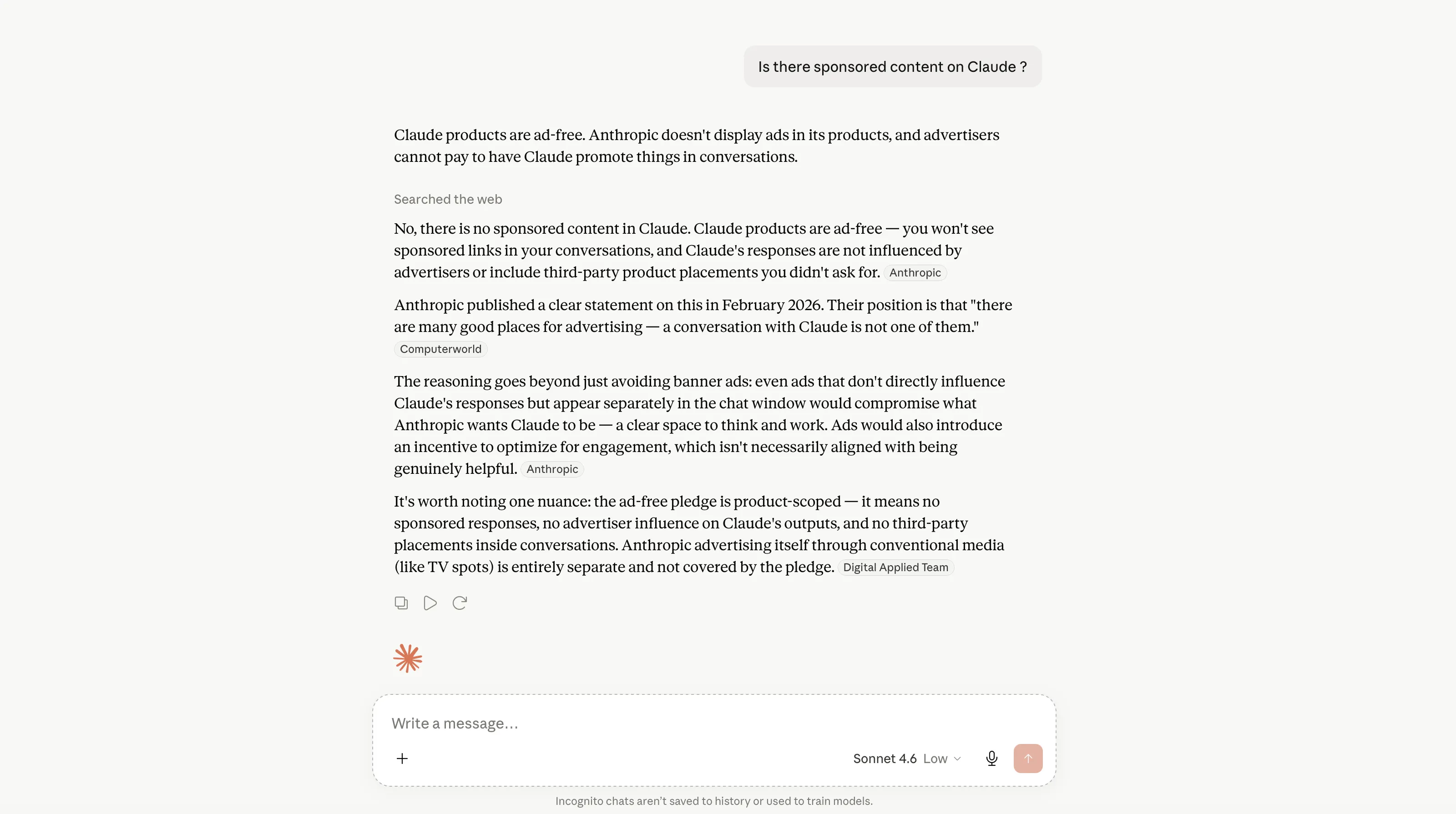
Claude cited a Value Chain Asia article labeled "Sponsored Content" on a Singapore logistics prompt. We checked if anyone else reported it.
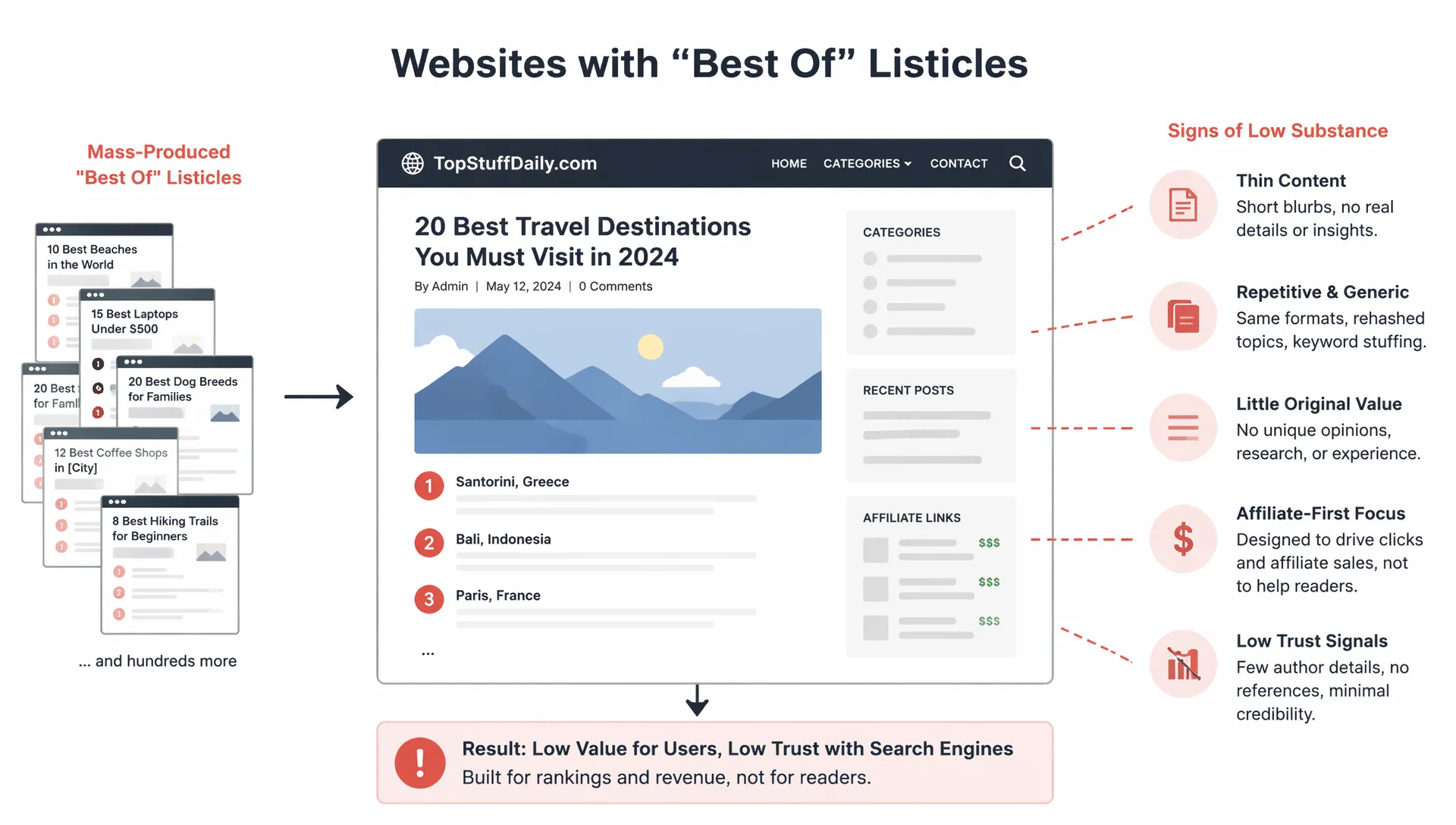
Google's June 2026 spam update targets thin listicles and AI citation manipulation. What B2B brands in Southeast Asia should audit, stop, and do instead.