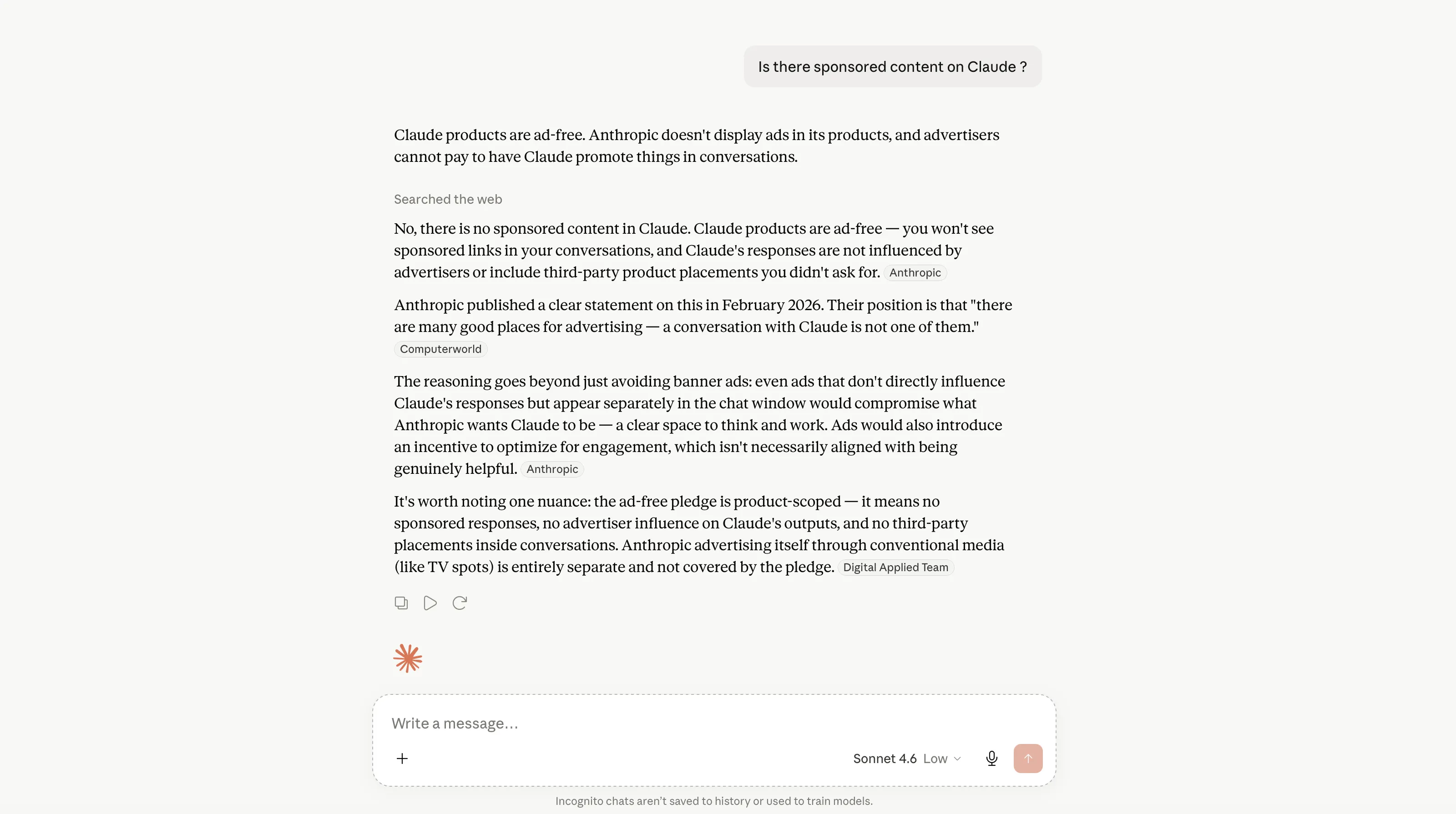
Did Claude start showing sponsored content? What we found in a Singapore logistics audit — and why it matters for B2B visibility
Claude cited a Value Chain Asia article labeled "Sponsored Content" on a Singapore logistics prompt. We checked if anyone else reported it.
During a four-week experiment tracking how B2B SaaS providers appear across four AI engines, we hit something we did not expect in Claude.
The prompt was plain buyer language — not a brand query, not a comparison request:
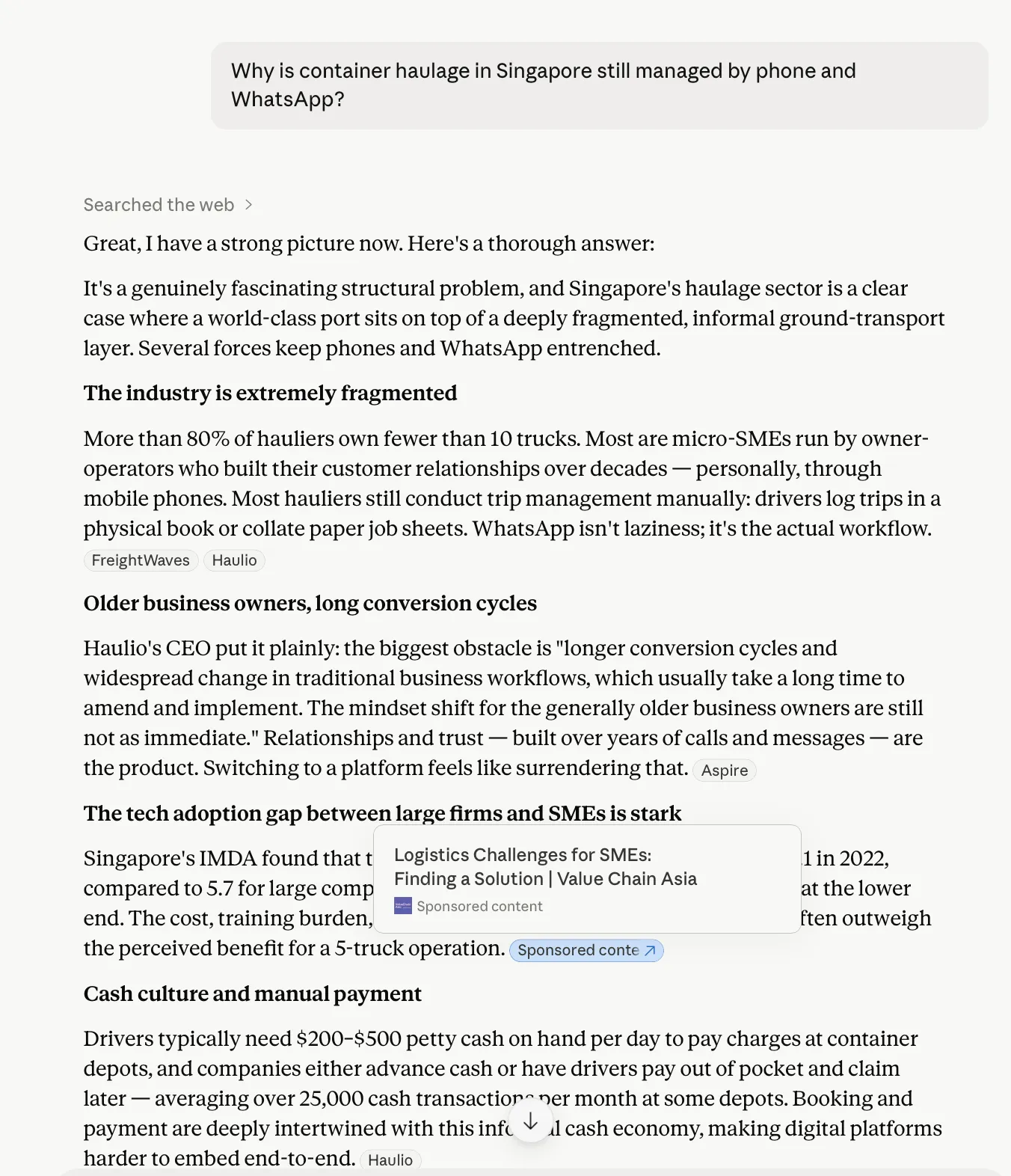
Why is container haulage in Singapore still managed by phone and WhatsApp?
We ran it from a Singapore IP as part of a wider audit spanning ChatGPT, Perplexity, Claude, and Google AI Overview across multiple B2B categories. Claude returned a grounded answer on logistics digitisation and SME constraints. One citation stood out.
Hovering the source chip showed:
Logistics Challenges for SMEs:Finding a Solution | Value Chain Asia
And beneath it, a secondary label: Sponsored Content.
Clicking through opened valuechainasia.com/logistics-smes-unappealing-outlook-solution/ — an article on Singapore logistics automation that reads as native trade media but promotes OnRobot’s D:PLOY cobot platform throughout.
That raised a fair question: did Claude start showing sponsored content to users?
We checked Anthropic’s public commitments, industry research, and whether anyone else had documented this exact UI behavior. Here is what we found — and what it means if you are building AI visibility strategy for a B2B brand in Southeast Asia.
What Anthropic says Claude will not do
On 4 February 2026, Anthropic published Claude is a space to think — a formal pledge that Claude will remain ad-free. The language is explicit:
Our users won’t see “sponsored” links adjacent to their conversations with Claude; nor will Claude’s responses be influenced by advertisers or include third-party product placements our users did not ask for.
This was timed deliberately. OpenAI had launched a self-serve ads manager for ChatGPT weeks earlier. Anthropic drew a product line: conversations with Claude are not an ad surface.
Industry summaries since then treat Claude as the major consumer AI assistant with no paid placement inventory — subscription and enterprise API revenue, not advertising.
So if you see the words “Sponsored Content” inside a Claude citation, the first instinct is: that contradicts the pledge.
It might not. The pledge covers Anthropic inserting ads. It does not necessarily cover Claude surfacing a publisher’s own content-type label when citing a third-party page that happens to be sponsored.
What we could find — and could not find — online
We searched for public reports of Claude citation hover cards labeled “Sponsored Content.” As of 26 June 2026, we did not find one.
What exists instead:
| Topic | What is documented | What is not |
|---|---|---|
| Claude ad-free pledge | Extensive coverage of Anthropic’s February 2026 commitment | No walk-back as of June 2026 |
| Claude web search backend | Brave Search; ~86.7% citation overlap with Brave organic results (BrightEdge analysis) | No public report of Claude rendering Brave paid units as citations |
| Paid content in AI citations generally | Muck Rack (May 2026): paid/advertorial ≈ 0.3% of AI citation links vs 84% earned media | Study measures link types in answers, not UI labels on hover cards |
| ChatGPT sponsored placements | OpenAI’s disclosed ad product — labeled, separate from organic citations | Different platform; not applicable to Claude’s UI |
| Claude citation hover behavior | Neutral POV documented hover cards showing publisher names (including mis-attributed pairs like “Tasnim news agency – Mehr News Agency”) | No prior “Sponsored Content” label report |
Bottom line: if this is happening broadly, it has not been written up publicly. Our observation may be among the first documented cases — at minimum, the first we could locate with that exact label text.
That does not prove rarity. Claude has ~19 million monthly active users. Most people do not screenshot citation hovers. But it does mean your competitors are probably not auditing for this yet — which is useful if you are listening to this research early.
What the cited page actually is
The Value Chain Asia URL is not a neutral explainer. Read end-to-end, it follows a classic native advertorial arc:
- Problem framing — Singapore logistics SMEs face labour shortages and an unappealing industry image
- Solution category — Industry 4.0 automation
- Product placement — OnRobot D:PLOY as the accessible automation path for SMEs
- Executive quote — James Taylor, CCO of OnRobot
The page title in search and social previews centres on logistics SME challenges. The commercial intent becomes clear only after scroll depth.
Claude still used it to ground claims about automation adoption in Singapore — including statistics on robot density and IMDA SME technology adoption gaps.
For a buyer researching why haulage brokers still run on WhatsApp, the answer may sound authoritative while partially resting on paid trade media. The “Sponsored Content” label appeared only on hover — not in the answer prose.
The likely explanation: metadata passthrough, not Claude ads
Claude’s web search runs on Brave Search. Research consistently shows Claude citing from Brave’s organic result pool, not sponsored link units. Anthropic’s API returns citation objects with url, title, and cited_text — fields populated from retrieval.
Trade publishers often expose content type in metadata:
- CMS category tags (“Sponsored Content”, “Partner Content”, “Brand Connect”)
- Open Graph or schema fields consumed by crawlers
- Title suffixes appended in the index
Claude’s hover card already surfaces publisher name and page title from retrieval. A “Sponsored Content” secondary label fits the same mechanism — the publisher told the index this is sponsored; Claude displayed it.
That interpretation aligns with:
- Anthropic’s ad-free pledge (no Anthropic ad slot)
- Brave organic-alignment research (no paid search unit)
- The Neutral POV precedent (hover cards reflect retrieval metadata, sometimes imperfectly)
It also aligns with what would worry a buyer if the alternative were true: Claude secretly auctioning citation slots. We have no evidence of that.
What we do have evidence of: sponsored publisher content entering Claude’s citation pool and grounding answers — with disclosure only if the user hovers.
Why this matters for B2B teams following our research
If you are tracking AI visibility — as a marketing leader, founder, or listener to this experiment — four implications follow.
1. Citation presence is not citation quality
Your audit should record who is named and what sources get cited. A competitor may appear in Claude’s answer not because independent analysts ranked them, but because a trade site sold native content that Brave indexed and Claude retrieved.
The Singapore Payroll AI Visibility Index already shows engine shortlists diverge. This finding adds a layer: even within Claude, the provenance of a citation can be commercial.
2. Sponsored trade media may work — with a trust tradeoff
Presenc AI and similar research note that indexed, substantive sponsored content in trade outlets can enter AI retrieval pools — unlike paywalled or noindex advertorials. If you sponsor Value Chain Asia–style content, you may earn citations.
But Claude surfaced the “Sponsored Content” label on hover. Buyers who inspect sources may discount the claim. Earned coverage still dominates citation share in aggregate (Muck Rack: 84% earned vs 0.3% paid/advertorial). Sponsored content is a lever, not the playbook.
3. Anthropic’s ad-free stance does not mean your category is ad-free
ChatGPT is building explicit ad products. Google enforces spam rules on manipulative AI citation tactics. Perplexity refused ads. Claude pledged ad-free.
Your buyer uses all of them. Category visibility strategy must be engine-specific — and now source-type-aware within each engine.
4. You are early if you audit hover labels
Most visibility audits stop at brand mentions. Few teams log citation hover text, publisher type, or sponsored labels. Running that protocol weekly — as we are in the four-week experiment — surfaces patterns before they show up in industry reports.
That early signal is the practical benefit of following this work: you see citation mechanics your competitors treat as invisible.
How to replicate this check in your category
- Write the prompt your buyer actually types — not your brand name. Use market-specific language (Singapore IP, local compliance terms, operational pain points).
- Query all four engines — ChatGPT, Perplexity, Claude, Google AI Overview. Same prompt, same session where possible.
- Hover every citation chip in Claude — record title, publisher, any secondary label (“Sponsored Content”, “Partner Content”, etc.), and URL.
- Classify each source — earned media, vendor-owned, review platform, sponsored/native, government, forum.
- Repeat on a schedule — weekly if you are running a tracker; monthly at minimum for high-intent categories.
If you want Citable to run this across your vertical, request a free AI visibility audit. If you are building an internal tracker, start from our baseline methodology and add a citation label column to your matrix.
What we are watching next
This is one observation from week one of a four-week, four-engine experiment. Open questions we are tracking:
- Frequency — does “Sponsored Content” appear on other Claude citations in logistics, or across payroll, fintech, and spend management prompts?
- Geography — is the label more common on Singapore IP sessions vs other ASEAN markets?
- Engine comparison — do ChatGPT, Perplexity, or Google AI Overview cite the same Value Chain Asia URL on the haulage prompt, and do they disclose sponsorship?
- Publisher pattern — which trade sites in Southeast Asia label sponsored content in metadata Claude exposes?
We will publish updates as the experiment continues. If you have seen the same “Sponsored Content” label in Claude — especially outside Singapore logistics — contact us with a screenshot. Reproducible reports help the whole community audit smarter.
The takeaway
Claude probably did not “start showing ads.” Anthropic’s pledge, Brave’s organic backend, and the absence of prior reports all point that way.
What Claude did do is cite publisher-sponsored content on a real buyer prompt — and surface “Sponsored Content” in the hover card, a label we could not find documented elsewhere.
For B2B brands in Southeast Asia, that distinction matters less than the practical outcome: your buyers may be forming opinions from AI answers partly grounded in paid trade media — and most marketing teams are not checking.
Audit the citations, not just the shortlist. That is where this experiment earns its keep.
Sources and methodology
Observation from Citable's four-week, four-engine B2B visibility experiment (ChatGPT, Perplexity, Claude, Google AI Overview) across multiple SaaS verticals. This finding came from a Singapore IP session on a logistics buyer prompt, 26 June 2026. External source review conducted same day. Screenshot evidence is in auditEvidence above. This article reports an observational finding, not a claim about Anthropic's commercial roadmap.
Citable audit data (primary)
- Citable four-engine B2B visibility experiment — Singapore logistics prompt, Claude citation observation (26 June 2026)
Observed in AI engine responses
Listed for transparency; Citable does not endorse third-party content.
- Value Chain Asia — Logistics SMEs unappealing outlook solution (retrieved 26 June 2026)
Policy and third-party references
- Anthropic — Claude is a space to think (ad-free pledge) (retrieved 26 June 2026)
- BrightEdge — Claude Search guide (Brave Search backend) (retrieved 26 June 2026)
- Muck Rack Generative Pulse — earned vs paid citation share (May 2026) (retrieved 26 June 2026)
- Neutral POV — Claude citation hover label behavior (Mehr News case) (retrieved 26 June 2026)
Frequently asked questions
- Does Claude show ads or sponsored content in its answers?
- Anthropic published a formal ad-free pledge on 4 February 2026: Claude will not show sponsored links adjacent to conversations, will not let advertisers influence responses, and will not include third-party product placements users did not request. That pledge covers Claude's own ad surfaces — not whether a cited publisher labels its article as sponsored content in page metadata that Claude passes through in citation hover cards.
- What did Citable observe in the Singapore logistics audit?
- During a four-week experiment tracking B2B SaaS visibility across ChatGPT, Perplexity, Claude, and Google AI Overview, we queried Claude from a Singapore IP with the prompt "Why is container haulage in Singapore still managed by phone and WhatsApp?" Claude cited Value Chain Asia. The hover card showed the title "Logistics Challenges for SMEs:Finding a Solution | Value Chain Asia" with a secondary label reading "Sponsored Content." The destination URL was valuechainasia.com/logistics-smes-unappealing-outlook-solution/.
- Has anyone else reported Claude showing "Sponsored Content" on citations?
- As of 26 June 2026, we found no other public report documenting Claude citation hover cards explicitly labeled "Sponsored Content." Coverage of Claude's ad-free stance is extensive. Research on Claude's Brave Search backend focuses on organic alignment. ChatGPT's separate sponsored placement product (launched February 2026) is documented — but that is a different mechanism from what we observed in Claude's citation UI.
- If Claude is ad-free, why did the citation say "Sponsored Content"?
- The most plausible explanation is metadata passthrough: the publisher (Value Chain Asia) marks certain articles as sponsored or native content in page title, Open Graph, or CMS fields. Claude's citation hover card surfaces publisher and title from retrieval — similar to how other engines show publisher names. That is different from Anthropic inserting paid placement into the answer stack. The article itself reads as an advertorial for OnRobot's D:PLOY cobot platform.
- Why should B2B marketing teams care about sponsored citation labels?
- Buyers treat AI answers as neutral research. If a cited source is commercially sponsored but the answer prose does not flag it, your competitor may appear because a publisher sold native content — not because an engine independently ranked them. Conversely, if you invest in sponsored trade media, Claude may surface that label to users who hover, reducing trust. Either way, citation quality matters as much as citation presence.
- How should we audit for this in our category?
- Run your buyer prompts across all four engines from the markets you serve. Record not just who is named but which sources are cited. Hover every citation chip and note labels like "Sponsored Content," publisher type, and URL. Compare Claude against ChatGPT, Perplexity, and Google AI Overview on the same prompt — engine source pools diverge. Repeat weekly if you are running a tracker experiment.
More visibility research
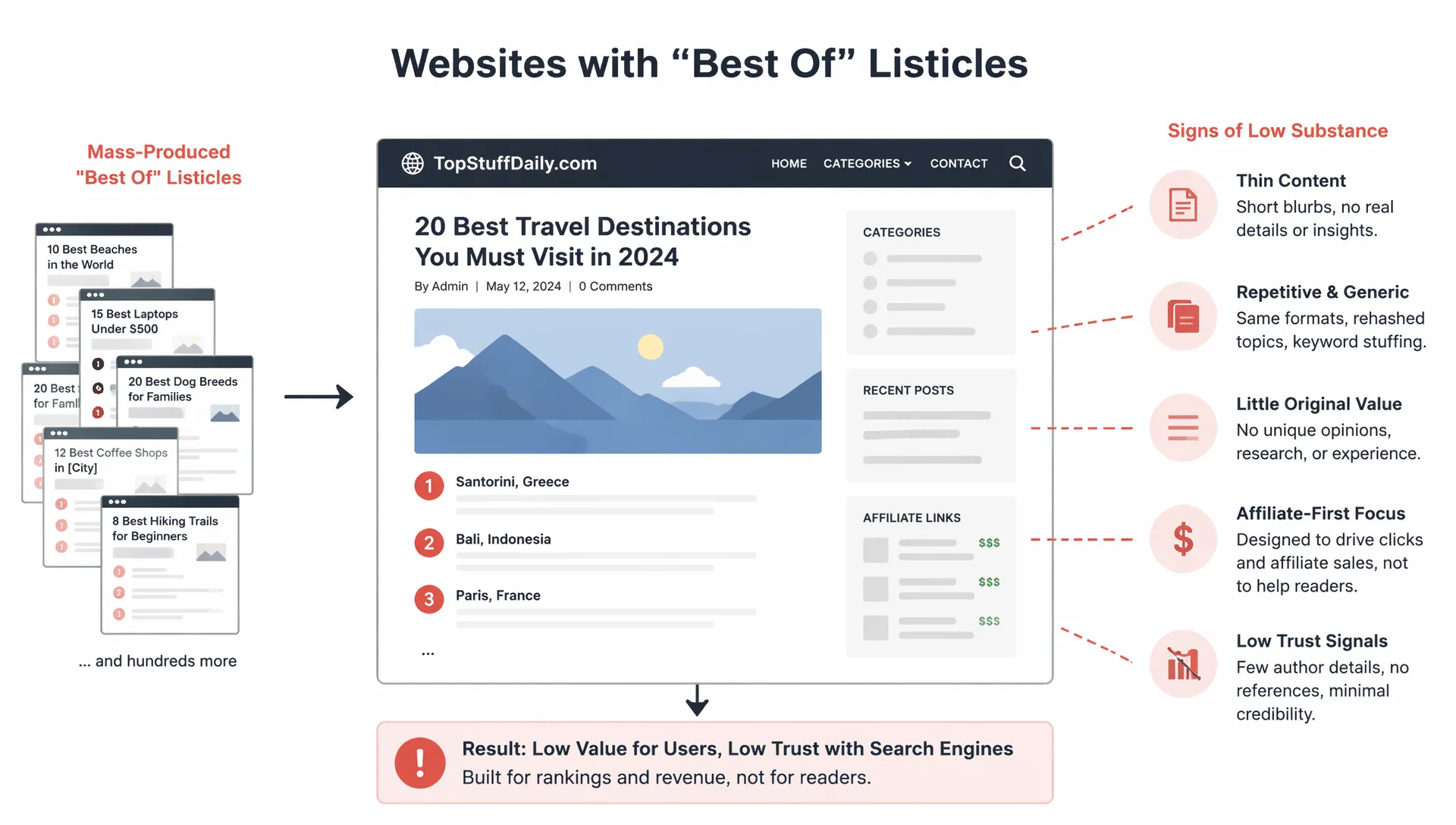
Google's June 2026 spam update targets thin listicles and AI citation manipulation. What B2B brands in Southeast Asia should audit, stop, and do instead.
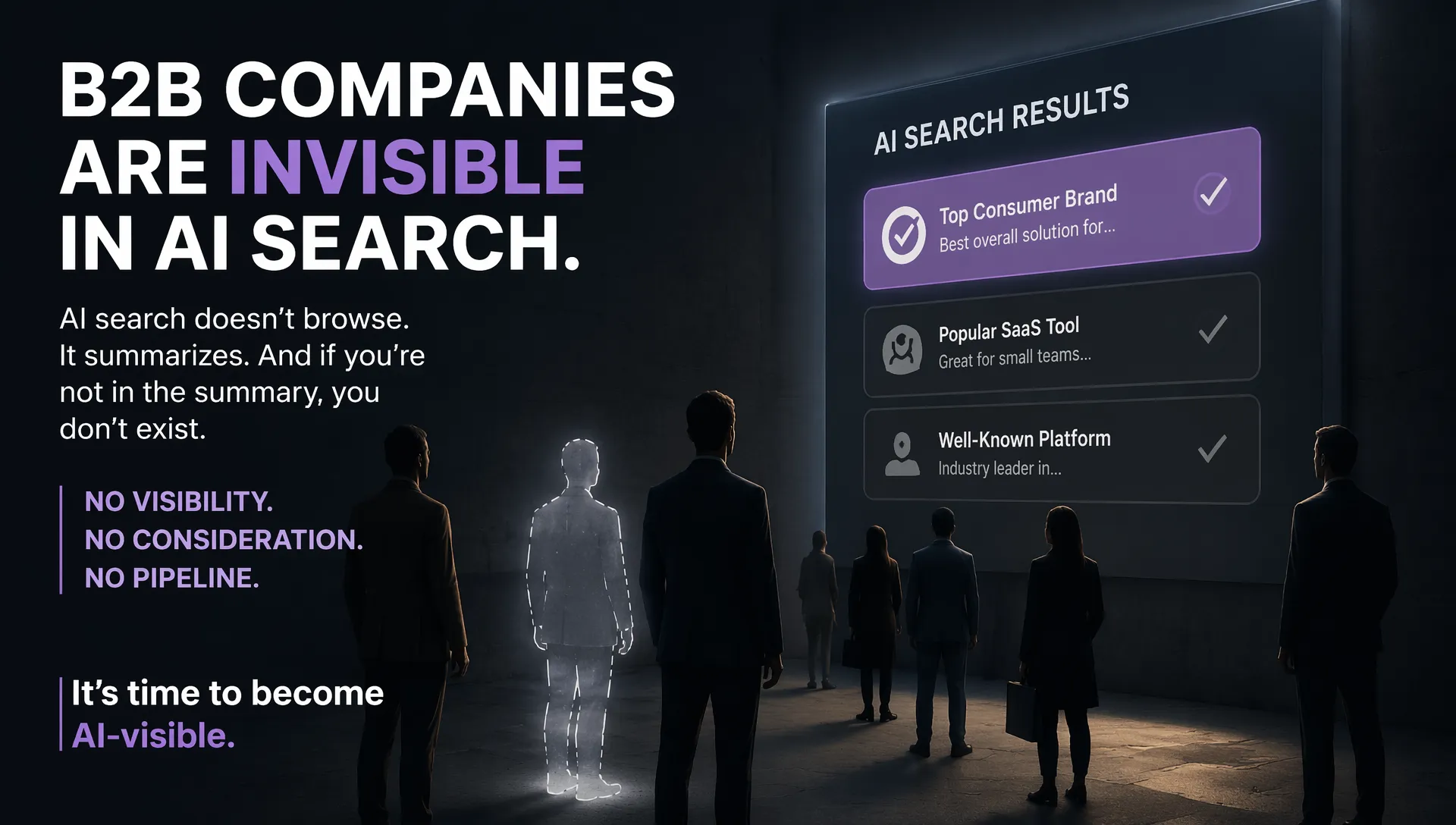
Why Singapore B2B companies are invisible in AI search — and why most don't know it yet
B2B buyers in Singapore research software in ChatGPT and Perplexity. Most local SaaS companies have no AI visibility strategy yet.