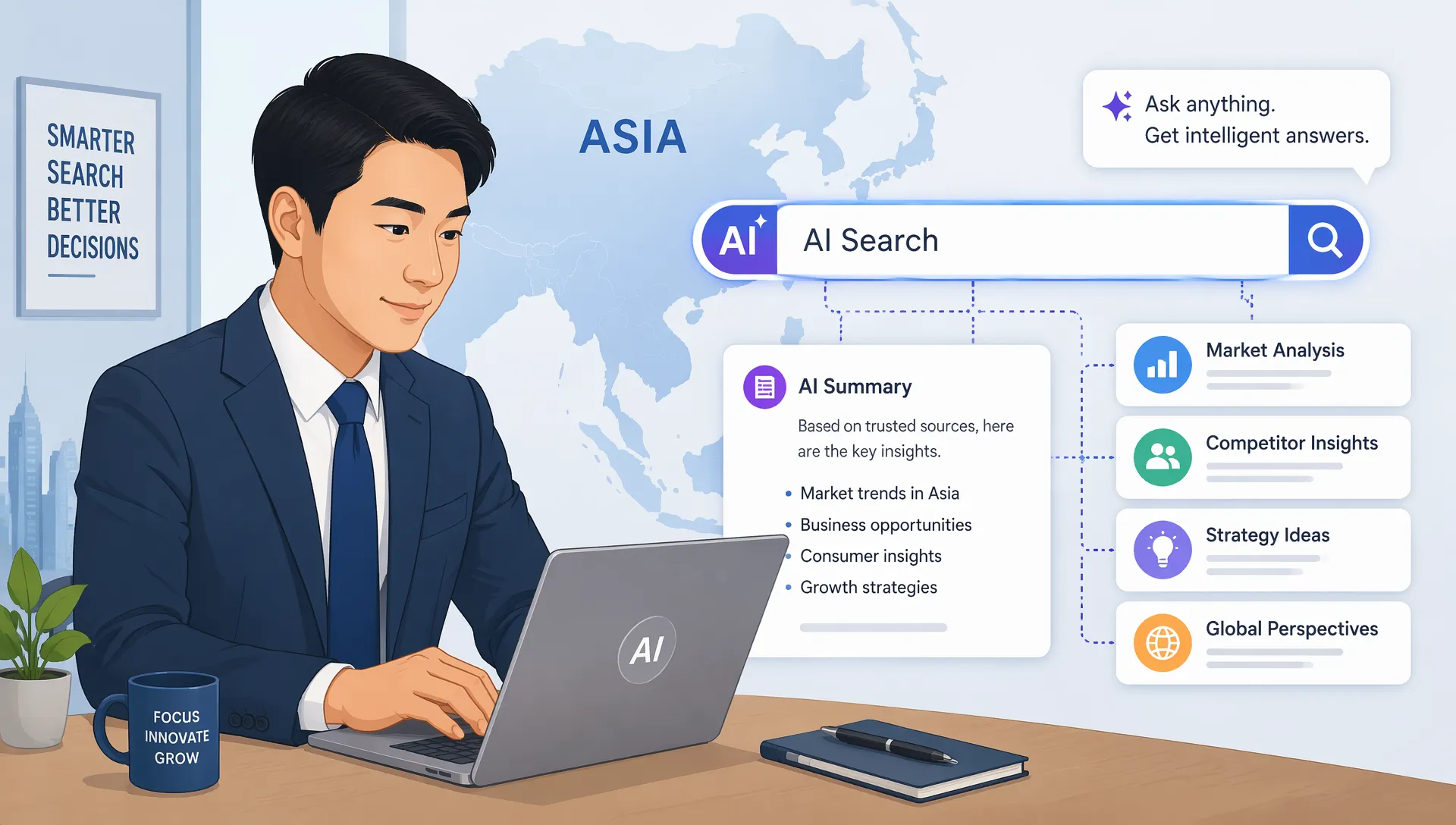
Why Southeast Asia B2B buyers are switching to AI search faster than Western markets
SEA B2B buyers adopt AI search fast — but not for every reason the headlines claim. What the data says, what we agree with, and what vendors get wrong.
Southeast Asia B2B buyers are switching to AI search faster than Western markets — or so the headlines claim. GEO agencies, Alibaba seller blogs, and LinkedIn threads all say the same thing: ASEAN procurement teams have moved on from Google, ChatGPT is the new front page, and vendors who optimise for blue links are already losing.
Part of that is true. Mobile-first adoption, local-language prompts, and thinner third-party content in Bahasa and Thai do make AI search behaviour in SEA distinct from the US or Europe. But the popular narrative oversimplifies — and several claims circulating online do not hold up when you read the underlying data or run the prompts yourself.
This article separates what holds up from what does not, connects online claims to primary evidence, and explains what Singapore-founded B2B vendors should actually do about it.
What people are saying online
These are the claims we see most often in SEA marketing and GEO content in 2026:
| Claim | Typical source | What it implies |
|---|---|---|
| “B2B buyers no longer use Google — they ask ChatGPT” | Simaia, ABKE, export-focused GEO blogs | SEO is dead in SEA; only AI visibility matters |
| “SEA AI search referral traffic is growing 190–210% YoY — fastest globally” | Mavic AI, upGrowth reports | SEA is permanently ahead of the West |
| “90%+ of internet users in Indonesia, Philippines, Malaysia use AI monthly” | Digital 2026, Siana marketing stats | Every buyer already researches in ChatGPT |
| “60–70% of B2B buyers in APAC use AI for supplier recommendations” | ABKE, Construct Digital | APAC B2B is far ahead of US/Europe |
| “ChatGPT dominates everywhere — test ChatGPT and you’re covered” | Most global SEO/GEO guides | One engine, one strategy |
| “SEA buyers skip sales reps and self-serve entirely via AI” | Various LinkedIn posts | Human validation is over |
Below is where Citable agrees, where we push back, and why — including evidence from our own cross-market audit of payroll buyer prompts in Singapore, Malaysia, and Indonesia.
What we agree with — and why
1. Southeast Asia is mobile-first for AI entry
The claim: In the West, AI search started on desktop browsers as a sidebar on Google. In SEA, it started inside mobile apps — ChatGPT, Gemini on Android, super-app integrations.
Our view: Agree.
Public First polling for Google (February–March 2025, n=6,492) found 76% of Southeast Asians first used AI through an app on an Android device. Mavic AI’s SEA playbook argues this changes the research interface: SEA buyers encounter AI as a chat window from day one, not as an optional box above ten blue links.
Why it matters for B2B: A Singapore HR director researching payroll software on a phone may never see your desktop-optimised homepage. They get a synthesized answer. If your brand is not in that answer, the website does not get a chance.
2. Gemini matters more in SEA than global averages suggest
The claim: ChatGPT leads globally, but Gemini’s effective share is higher in Indonesia and the Philippines because of Android default integration.
Our view: Agree — and most Western-focused GEO advice ignores this.
Global share figures (ChatGPT ~64–68%, Gemini ~18–21% per Similarweb Q1 2026) understate Gemini in mobile-first ASEAN markets. Google’s e-Conomy SEA 2025 report notes consumer interest in AI features runs 3× the global average in the region.
Why it matters: A vendor testing only ChatGPT in Singapore and assuming that covers ASEAN is under-testing. Indonesia and Philippines buyers may hit Gemini before ChatGPT.
3. Local language splits the shortlist — especially in Indonesia
The claim: SEA buyers research in Bahasa, Thai, and Vietnamese — not only English — and AI answers differ by language.
Our view: Strongly agree — this is primary evidence, not survey data.
In Citable’s 26 June 2026 audit, Perplexity on an English Jakarta payroll prompt named Mekari Talenta, Gadjian, and Peoplyee. The Bahasa Indonesia prompt on the same engine named Gadjian, SatuHR, and GajiHub — and did not name Mekari Talenta, despite it being the market leader in English and in Google AI Overview.
Western B2B research is overwhelmingly English. SEA adds a language dimension Western markets do not face at the same scale. That is a genuine structural difference — not just faster adoption of the same behaviour.
4. AI search referral traffic in SEA is growing fast
The claim: AI referral traffic from India and Southeast Asia is growing 190–210% year-over-year — among the fastest globally (upGrowth / Mavic AI, 2026).
Our view: Agree on direction, cautious on magnitude.
Referral traffic growth is a real signal. It measures clicks from AI platforms to websites — not shortlist formation inside the chat window, which often happens with zero clicks. Still, the direction is clear: more SEA users are arriving via AI surfaces, and the curve is steep.
Why it matters: Even if the exact percentage is debatable, waiting for “official” B2B benchmarks before auditing your category means competitors compound citation authority first.
5. B2B software buyers globally are crossing the AI-first threshold
The claim: A majority of B2B software buyers now start research in AI.
Our view: Agree — but this is global, not SEA-specific.
G2’s March 2026 survey (n=1,076, North America, EMEA, and APAC) found 51% of B2B software buyers start research with an AI chatbot more often than Google — up from 29% eleven months earlier. 71% use AI somewhere in the software research process.
This is the most credible B2B-specific benchmark available. It confirms the shift is real. It also shows Western buyers are not standing still — the global curve is steep everywhere.
What we push back on — and why
1. “B2B buyers have stopped using Google”
The claim: Supplier discovery in Vietnam, Indonesia, and the Philippines “is not Google anymore” — buyers go straight to ChatGPT.
Our view: Disagree. Overstated.
G2’s data shows 51% start with AI more often than Google — not instead of Google. Buyers use an average of seven information sources (Gartner, 2025). In our cross-market audit, Google AI Overview appeared in all three countries and often surfaced different vendors than conversational AI on the same topic.
Google is not gone. It has become an AI surface itself. Treating SEO and AI visibility as either/or is how vendors miss half the picture.
2. “General population AI usage = B2B software research”
The claim: Indonesia at 93.6% monthly AI tool usage (Digital 2026) means nearly every B2B buyer researches software in ChatGPT.
Our view: Disagree. Category error.
Monthly AI tool usage includes image generation, translation, homework, and productivity tasks — not procurement. Google’s e-Conomy SEA survey found 30% of digital-economy users say AI helps them discover brands they would otherwise miss. That is consumer discovery behaviour, not “CFO shortlists payroll software in ChatGPT.”
Use B2B software-specific benchmarks (G2’s 51%, Gartner’s 45% GenAI use in a recent purchase) — not population-wide AI adoption rates.
3. “SEA is permanently ahead and Western markets won’t catch up”
The claim: SEA’s 190–210% AI referral growth means a durable, widening gap over the US and Europe.
Our view: Partially disagree. The gap is real but closing.
G2’s global data shows Western B2B software buyers went from 29% to 51% AI-first in eleven months. That is not a market standing still. SEA’s lead is less about a higher eventual ceiling and more about different entry points (mobile, Gemini, local language) and less legacy content infrastructure in local languages.
Within five years, both regions will treat AI as a default research layer. SEA vendors who act now build citation authority early. But framing this as “SEA forever ahead” creates complacency — Western competitors learning GEO will apply the same tactics to ASEAN category prompts.
4. “Test ChatGPT and you’re covered”
The claim: ChatGPT is 63% of B2B software AI research (G2). Optimise for ChatGPT.
Our view: Disagree for SEA. Insufficient alone.
Our audit shows engines disagree within the same market. Swingvy appeared in Malaysia ChatGPT and Google AI Overview on 26 June 2026 but was absent from Singapore ChatGPT on the same day. Perplexity’s Malaysia shortlist (Omni HR, HavaHR, PayrollPanda) differed entirely from ChatGPT’s seven vendors.
ChatGPT is the largest single engine globally. It is not the only engine that shapes ASEAN buyer shortlists.
5. “Buyers self-serve entirely — sales reps are out of the loop”
The claim: AI has replaced the vendor conversation; buyers arrive with a fixed shortlist.
Our view: Disagree for enterprise B2B.
Gartner (May 2026) found 69% of B2B buyers prefer to validate AI-generated insights with sales reps at key decision points. AI forms the shortlist; humans still confirm compliance, pricing, and fit.
For SEA B2B SaaS, the implication is not “sales is dead” — it is your brand must survive the AI shortlist to get the validation conversation at all.
What SEA is actually doing differently — a synthesis
Western and Southeast Asian B2B buyers are both moving to AI search. The difference is not a magical ASEAN leapfrog. It is four structural factors:
| Factor | Western markets | Southeast Asia |
|---|---|---|
| Primary device | Desktop-first research legacy | Mobile-first, chat-interface native |
| Language | English dominates B2B | Bahasa, Thai, Vietnamese, Malay split source pools |
| Dominant AI entry | ChatGPT + Google AIO on desktop | ChatGPT + Gemini (Android) + Google AIO |
| Third-party content | Deep G2, Gartner, Forrester layer | Thinner local-language comparators — AI fills gaps |
| B2B AI-first rate | ~51% global (G2, incl. EMEA + APAC) | Likely at or above global average in software categories, but not 90% |
The last row matters: SEA is probably at or slightly ahead of the global B2B curve in software categories where English fluency is high (Singapore fintech, regional SaaS). It is dramatically different — not necessarily faster — in markets where Bahasa or Thai prompts pull entirely separate citation pools (Indonesia, Thailand).
What our audit adds that surveys cannot
Surveys tell you buyers say they use AI. Prompt audits tell you who AI names when they do.
From Citable’s 26 June 2026 cross-market payroll audit:
- PayrollPanda was the only vendor named across all four surfaces in Malaysia. No Singapore vendor achieved that consistency.
- Swingvy appeared in Malaysia ChatGPT but not Singapore ChatGPT — regional expansion without regional AI visibility.
- Mekari Talenta disappeared from Bahasa Perplexity but appeared in English Perplexity and Google AI Overview — language is not a translation problem, it is a separate visibility profile.
These are the mechanics behind the headline. SEA buyers are not uniformly “ahead.” They are fragmented by country, language, and engine — which is harder to manage than a single global AI strategy.
Full tables: How B2B buyers in Singapore, Malaysia, and Indonesia research software.
What Singapore-founded B2B vendors should do
Do not wait for Western benchmarks to “trickle down” to ASEAN. The shift is already here — G2’s 51% is global, and our audit shows category shortlists forming in AI answers today.
Do not assume one English blog post covers Indonesia. Run Bahasa buyer prompts. If your brand disappears, you need local-language comparison content or third-party mentions — not a translated homepage.
Do not optimise for ChatGPT alone. Test Perplexity, Claude, Google AI Overview, and Gemini in each target market.
Do audit the exact prompts your buyers type — per country, per language. Request a free AI visibility audit or replicate the protocol from our cross-market research.
Do read this alongside why Singapore B2B companies are invisible in AI search — the visibility problem is already local, not imported from the West.
The bottom line
Southeast Asia B2B buyers are switching to AI search faster than Western markets in specific ways: mobile entry, local-language prompts, Gemini’s regional weight, and thin local comparator content that forces AI to synthesize from whatever exists.
They are not switching in the ways viral GEO posts often claim: Google is not dead, 93% population AI usage is not 93% B2B procurement, and ChatGPT alone is not the whole shortlist.
The vendors who win are not the ones who repeat the hype. They are the ones who run the prompts, record who appears, and fix the gaps — market by market, language by language, engine by engine.
That is what AI search visibility for B2B brands in Southeast Asia actually requires.
Sources and methodology
Third-party statistics are cited with source and date. Where surveys are global (G2) or consumer-weighted (Digital 2026, Public First), we note the limitation. Citable primary evidence is from a controlled payroll buyer-prompt audit across Singapore, Malaysia, and Indonesia on 26 June 2026.
Citable audit data (primary)
- Citable cross-market audit — SG, MY, ID payroll buyer prompts, 26 June 2026
Policy and third-party references
- G2 — The Answer Economy (2026 AI Search Insight Report, March 2026) (retrieved 17 July 2026)
- Google — e-Conomy SEA 2025 (AI for business growth) (retrieved 17 July 2026)
- Public First — The AI Opportunity in Southeast Asia (Google handout) (retrieved 17 July 2026)
- Mavic AI — GEO in South East Asia 2026 Marketer's Playbook (retrieved 17 July 2026)
- Gartner — B2B buyers validate AI insights with sales reps (May 2026) (retrieved 17 July 2026)
- How B2B buyers in Singapore, Malaysia, and Indonesia research software (Citable) (retrieved 17 July 2026)
Frequently asked questions
- Are Southeast Asia B2B buyers really switching to AI search faster than Western markets?
- Partially yes. SEA leads on mobile-first AI adoption, Android-integrated Gemini usage, and local-language prompts — especially in Indonesia and the Philippines. But global B2B software research data (G2, March 2026) shows 51% of buyers worldwide now start in an AI chatbot more often than Google. The gap is narrowing fast; SEA's lead is about how buyers research, not whether Western buyers will eventually catch up.
- Have B2B buyers in Southeast Asia stopped using Google?
- No. Even vendors claiming AI has replaced Google acknowledge buyers still use search engines alongside chatbots. G2 reports 71% of B2B software buyers use AI somewhere in research — not instead of all other channels. In SEA, Google AI Overview remains a primary surface, often in local languages. AI search supplements and reshapes Google; it has not replaced it.
- Why does language matter more for AI search in Southeast Asia?
- Citable's cross-market audit found that an English Perplexity prompt and a Bahasa Indonesia prompt on the same engine returned different vendor shortlists — Mekari Talenta appeared in English but not in Bahasa. Western markets research predominantly in English; SEA buyers prompt in Bahasa Indonesia, Thai, Vietnamese, and Malay, which pulls a different source pool entirely.
- Which AI engines matter most in Southeast Asia vs the West?
- ChatGPT leads globally, but Gemini's effective share is higher in SEA than in the US or Europe because of Android integration — particularly in Indonesia and the Philippines. Western enterprise buyers skew toward ChatGPT and Copilot. SEA B2B vendors optimising for ChatGPT alone miss Gemini and Google AI Overview, which many buyers encounter first on mobile.
- What should Singapore B2B companies do about this trend?
- Audit AI visibility per market and per language — not assume global English content covers ASEAN. Test buyer prompts in ChatGPT, Perplexity, Claude, and Google AI Overview for Singapore, Malaysia, and Indonesia separately. Build or earn citation in local comparison content, not only on your homepage.
- Is high general AI usage the same as B2B software buyers using AI?
- No. Surveys showing 90%+ monthly AI tool usage in Indonesia or the Philippines measure general population adoption — image generation, homework help, productivity tasks. B2B software procurement is a narrower behaviour. G2's 51% figure for AI-first software research is the more relevant benchmark, and it applies globally, not only in SEA.
More Southeast Asia market analysis

Singapore Airlines and AirAsia dominate SEA travel AI answers — Travel AI Visibility Index, Week 1
Week 1 index: SIA leads full-service and AirAsia leads budget — even when prompts are asked from Japan or Indonesia.
DBS owns trust. Trust Bank owns digital. Singapore Banking AI Visibility Index — Week 1
Week 1 index: who ChatGPT, Perplexity, Gemini, and Google AI Mode name for Singapore banking, digital banks, and remittance.