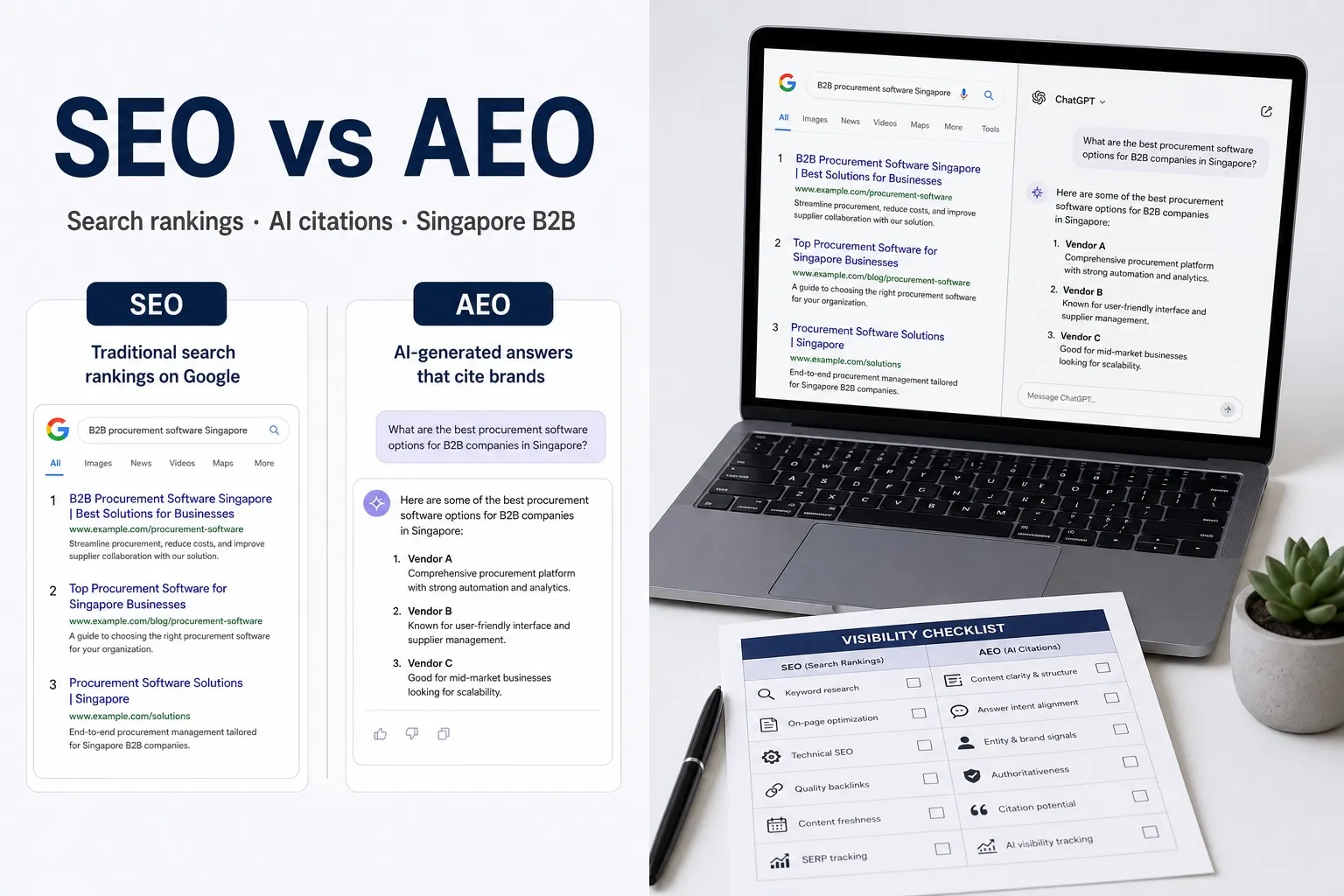
What is AEO and how is it different from SEO — a guide for Singapore B2B marketers
What is AEO, GEO, and how do they differ from SEO? A practical explainer for Singapore B2B marketing teams building visibility in AI search.
SEO ranks your website in Google’s search results. AEO (Answer Engine Optimisation) gets your brand named inside AI-generated answers in ChatGPT, Perplexity, and Google AI Overview. They are related disciplines with different success metrics — and Singapore B2B marketers need both, because buyers now research in AI tools before they click a single search result.
The terms at a glance
Three acronyms dominate the conversation in 2026. They overlap but are not interchangeable.
SEO (Search Engine Optimisation) is the established practice of improving your website’s visibility in traditional search engine results — primarily Google’s organic blue links. Success is measured in ranking position, click-through rate, and organic traffic. SEO has twenty years of methodology, tooling, and agency expertise behind it.
AEO (Answer Engine Optimisation) targets a newer outcome: being named and cited inside AI-generated answers. When a buyer asks ChatGPT “Which cross-border payment platform should a Singapore company use for ASEAN suppliers?”, AEO asks whether your brand appears in the response — not whether your homepage ranks on page 1. Success is measured in citation rate, brand mention frequency, and share of voice across AI engines.
GEO (Generative Engine Optimisation) is often used interchangeably with AEO. Both refer to optimising for generative AI systems — ChatGPT, Perplexity, Claude, Google AI Overview — rather than traditional search rankings. Some practitioners treat GEO as the umbrella term and AEO as the answer-specific subset, but no industry standard definition exists yet.
Google AI Overview sits between SEO and AEO. It appears inside Google search results and draws from Google’s index — so SEO fundamentals still matter. But it synthesises an answer rather than listing links, which means the visibility rules differ from blue-link ranking.
ChatGPT and Perplexity are fully conversational surfaces with their own retrieval and citation pools. Optimising for Google alone does not cover them.
What does SEO actually do for B2B marketers?
SEO for a Singapore B2B SaaS company typically focuses on:
- Keyword targeting — ranking for category terms like “payroll software Singapore SME” or “cross-border payments ASEAN”
- On-page optimisation — title tags, meta descriptions, header structure, internal linking
- Technical health — site speed, mobile responsiveness, crawlability, schema markup
- Authority building — backlinks, domain authority, brand mentions in established publications
- Content marketing — blog posts, case studies, landing pages that attract organic traffic
The outcome: when a buyer searches on Google, your page appears as a clickable result. Marketing teams track this with keyword rankings, organic sessions, and conversion rates from search.
For two decades, this was the primary discoverability channel for B2B software. It still matters — but it is no longer the only channel that shapes vendor shortlists.
What is AEO and why did it emerge?
AEO emerged because buyer behaviour shifted. When a Singapore HR director asks ChatGPT which payroll platforms handle CPF and IRAS compliance, the answer names specific vendors directly — no search results page, no clicking through ten blue links. The shortlist forms inside the AI response.
AEO optimises for that moment. The goal is not a ranking position but inclusion in the generated answer. Specifically:
- Your brand is named when buyers ask category questions
- Your content is cited as a source (especially visible in Perplexity’s inline citations)
- Your company appears across multiple AI engines, not just one
The tactics overlap with SEO — quality content, authority signals, structured data — but the measurement and source pools differ. AI engines do not mirror Google’s ranking order. They synthesise from comparison articles, government references, review platforms, and third-party explainers that name multiple products with factual context.
Citable’s visibility research documented this with a concrete example: Swingvy, a Singapore HR and payroll SaaS company, appeared in Google AI Overview for a payroll software query but was absent from ChatGPT, Perplexity, and Claude on the same buyer prompt. Strong local traction and active marketing did not translate into conversational AI visibility.
How is AEO different from SEO in practice?
The distinction is clearest when you compare what each discipline optimises for:
| Dimension | SEO | AEO |
|---|---|---|
| Primary surface | Google organic blue links | ChatGPT, Perplexity, Google AI Overview, Claude |
| Success metric | Ranking position, organic traffic | Brand named in AI answer, citation as source |
| Buyer behaviour | Buyer searches, clicks a result, reads your page | Buyer asks a question, receives a shortlist inside the AI response |
| Source pool | Google’s search index and ranking algorithm | Each engine’s own retrieval — training data, web browsing, RAG |
| Content that wins | Keyword-optimised pages, landing pages, blog posts | Structured comparisons, FAQ schema, neutral category guides |
| Typical tools | Ahrefs, Semrush, Google Search Console | Manual audit protocols, visibility trackers, citation monitoring |
| Maturity | 20+ years of established practice | Emerging — no standard methodology in Southeast Asia yet |
SEO asks: “Does our page rank for this keyword?” AEO asks: “Does ChatGPT recommend us when a buyer asks this question?”
Both questions matter. They just measure different outcomes on different surfaces.
Can SEO alone get you cited in ChatGPT and Perplexity?
No — not reliably. Three reasons explain why:
Different source pools. ChatGPT and Perplexity synthesise answers from sources that do not mirror Google’s ranking algorithm. Perplexity frequently cites third-party comparison articles and government pages rather than vendor homepages. ChatGPT may name vendors based on training data and browsing results that differ from current Google rankings.
Different output formats. SEO optimises for a page that ranks and gets clicked. AEO optimises for a brand name that appears inside a generated paragraph. A page-one ranking does not guarantee your company is extracted and named in an AI summary.
Engine disagreement is the norm. In Citable’s Singapore Payroll AI Visibility Index baseline, only 1 in 12 tracked vendors appeared on all four engines (ChatGPT, Perplexity, Claude, Google AI Overview). A vendor visible on Google was often absent from conversational AI — and vice versa.
This does not mean SEO is wasted effort. Google AI Overview pulls from Google’s index, so SEO still influences that surface. But SEO alone leaves ChatGPT and Perplexity uncovered — and buyers in Singapore are using all three.
Why does AEO matter specifically for Singapore B2B companies?
Singapore B2B markets have characteristics that make AEO urgent rather than optional:
English-language AI tools work well for local prompts. Buyers ask questions in English about Singapore-specific requirements — CPF compliance, IRAS filing, MAS regulations, cross-border ASEAN payments — and get usable answers. The research shift is already happening in software categories where Singapore has strong local vendors.
Local vendors compete against global incumbents. A Series B HR tech company with hundreds of Singapore customers can lose a deal to a competitor that invested in one well-structured comparison article targeting the exact prompt the buyer typed. AI engines recommend whoever appears in authoritative third-party sources — not whoever has the most customers.
The playbook is undefined in Southeast Asia. SEO has established agencies, certifications, and tooling. AEO has almost none of this in the region. Marketing teams assume their SEO programme covers AI visibility. It does not — and the gap is measurable.
Buyers do not tell you. When a prospect arrives with a shortlist already formed in Perplexity, they rarely mention it. You win or lose before the first conversation — and your marketing dashboard never shows why.
What content formats work for AEO?
AI engines extract comparative, factual, structured content most reliably. Formats that perform well:
- Category comparison guides — naming multiple vendors with factual criteria, pricing bands, and compliance requirements. See Best payroll software for Singapore SMEs as an example.
- FAQ blocks with schema markup — question-and-answer pairs that match buyer prompts, rendered as JSON-LD
- Original research and data — audit results, index tracking, benchmark reports that other publishers cite
- Government-aligned explainers — content that references IRAS, MOM, MAS, or other official sources AI engines already trust
Formats that perform poorly for AEO:
- Vendor homepages alone — AI engines rarely cite product pages as primary sources for category questions
- Thin “best of” listicles — Google’s June 2026 spam update now treats scaled comparison pages built to harvest AI citations as manipulative
- Branded content without category context — “About us” pages do not answer buyer-style prompts
Comparison table: SEO vs AEO vs GEO
| SEO | AEO | GEO | |
|---|---|---|---|
| Full name | Search Engine Optimisation | Answer Engine Optimisation | Generative Engine Optimisation |
| Optimises for | Google organic rankings | Brand citation in AI answers | Brand citation in generative AI |
| Primary surfaces | Google blue links | ChatGPT, Perplexity, Google AIO | All generative AI systems |
| Key metric | Keyword ranking, organic traffic | Citation rate, share of AI voice | Same as AEO (terms overlap) |
| Content focus | Keyword-targeted pages | Structured comparisons, FAQ schema | Same as AEO |
| Maturity in SG | Established | Emerging | Emerging (often used as AEO synonym) |
| Can replace the other? | No — needed for Google | No — needed for conversational AI | No — complementary to SEO |
In practice, treat AEO and GEO as the same discipline for now. Focus on the outcome — being named in AI-generated answers — rather than the acronym.
What should Singapore B2B marketers do first?
- Audit your current AI visibility. Before investing in AEO content, know where you stand. Run the manual check protocol across ChatGPT, Perplexity, and Google AI Overview with three to five buyer-style prompts.
- Keep your SEO fundamentals. Google AI Overview still draws from Google’s index. Technical health, helpful content, and earned backlinks remain valuable — they just are not sufficient alone.
- Publish one structured comparison per core category. Name competitors factually. Include compliance criteria, pricing bands, and a comparison table. This is the content format AI engines extract most reliably — and the format buyers trust.
- Track weekly, not once. AI engine shortlists shift as new content gets indexed and cited. A one-time check is a snapshot; weekly tracking catches movement.
- Avoid GEO shortcuts. Paid mention networks, scaled thin listicles, and manufactured comparison pages now carry spam enforcement risk from Google — and do not build durable citation authority in ChatGPT or Perplexity.
SEO got you found. AEO gets you recommended. Singapore B2B marketers who build both will own the shortlist at the point where purchase decisions begin — inside the AI answer, not after it.
If you want a baseline for your company across engines and categories, request a free AI visibility audit.
Sources and methodology
Definitions and distinctions reflect Citable's Singapore B2B AI visibility research (June–July 2026). AEO and GEO terminology is evolving; this guide uses the terms as they appear in practitioner and agency discourse in Southeast Asia as of mid-2026.
Citable audit data (primary)
- Citable visibility audit — Swingvy payroll test, 26 June 2026
Observed in AI engine responses
Listed for transparency; Citable does not endorse third-party content.
- OpenAI — ChatGPT (retrieved 16 July 2026)
- Perplexity — AI search (retrieved 16 July 2026)
Policy and third-party references
- Google Search Central — Creating helpful, reliable, people-first content (retrieved 16 July 2026)
- Google Search Central — Spam policies for Google web search (retrieved 16 July 2026)
- Why Singapore B2B companies are invisible in AI search (Citable visibility research) (retrieved 16 July 2026)
- Singapore Payroll AI Visibility Index — baseline (Citable research) (retrieved 16 July 2026)
- How to check if your Singapore company appears in ChatGPT and Perplexity (Citable guide) (retrieved 16 July 2026)
Frequently asked questions
- What is AEO in marketing?
- AEO stands for Answer Engine Optimisation — the practice of structuring content so AI-powered answer engines (ChatGPT, Perplexity, Google AI Overview, Claude) name and cite your brand when buyers ask category questions. Unlike SEO, the goal is not a ranking position but inclusion inside the generated answer itself.
- What is the difference between SEO and AEO?
- SEO targets Google's organic search rankings — getting your page to appear as a blue link on page 1. AEO targets AI-generated answers — getting your brand named when a buyer asks "Which payroll software should a Singapore SME use?" inside ChatGPT or Perplexity. They use overlapping tactics (quality content, authority signals) but measure different outcomes.
- Is GEO the same as AEO?
- GEO (Generative Engine Optimisation) and AEO (Answer Engine Optimisation) are largely interchangeable terms in 2026 marketing discourse. Both refer to optimising for citation in generative AI systems rather than traditional search rankings. Some practitioners use GEO for the broader discipline and AEO for answer-specific tactics, but no standard definition exists yet.
- Can good SEO get my company cited in ChatGPT?
- Not reliably. AI engines synthesise answers from a different source pool than Google's ranking algorithm uses. Citable's June 2026 audit found a Singapore payroll vendor appearing in Google AI Overview but absent from ChatGPT, Perplexity, and Claude on the same buyer prompt. Page-one SEO and AI citation are related but not equivalent.
- Which AI engines should Singapore B2B marketers optimise for?
- Test and optimise for ChatGPT, Perplexity, and Google AI Overview at minimum — these three surfaces cover the majority of B2B software research in Singapore. Claude is a useful fourth check. Each engine returns different shortlists for the same prompt, so optimising for one alone leaves gaps.
- Do I need to stop doing SEO to focus on AEO?
- No. SEO and AEO are complementary, not either/or. Google AI Overview pulls from Google's search index, so strong SEO still helps AI visibility on that surface. But SEO alone does not cover ChatGPT or Perplexity, which use separate retrieval and citation pools. Singapore B2B teams should maintain SEO fundamentals while adding AEO-specific content and audit practices.
- How do I start with AEO as a Singapore B2B marketer?
- Run a baseline visibility audit: test three to five buyer-style prompts across ChatGPT, Perplexity, and Google AI Overview, record whether your brand is named, and identify which competitors appear instead. Then publish structured comparison content that names multiple vendors with factual criteria — the format AI engines extract most reliably.
More B2B visibility guides
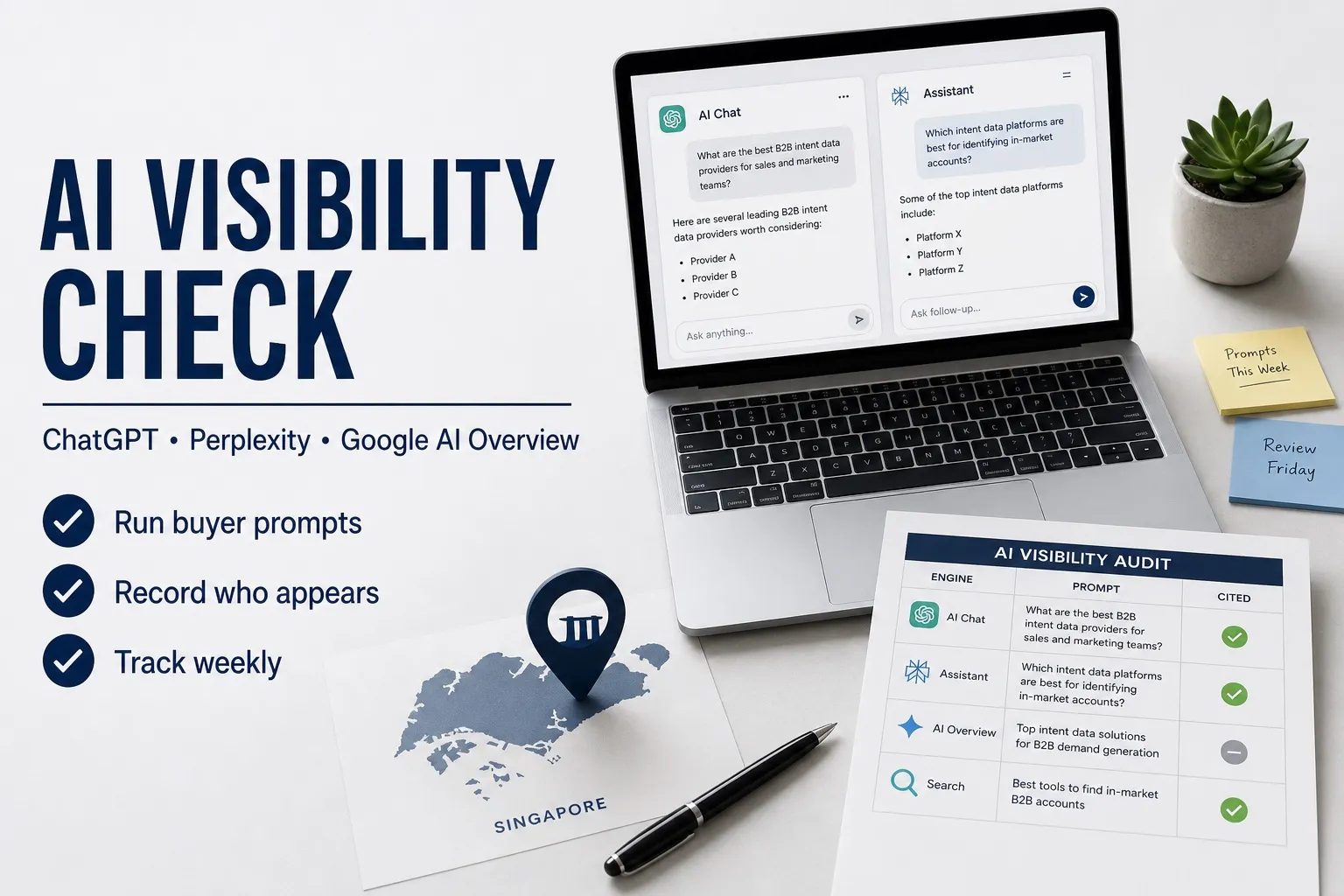
How to check if your Singapore company appears in ChatGPT and Perplexity
Step-by-step guide for Singapore B2B teams to test whether your company appears in ChatGPT, Perplexity, and Google AI Overview — and what to record.
Best payroll software for Singapore SMEs — 2026 comparison
A factual comparison of payroll software for Singapore SMEs — CPF, SDL, IRAS filing, pricing, and which platforms AI search engines recommend in 2026.