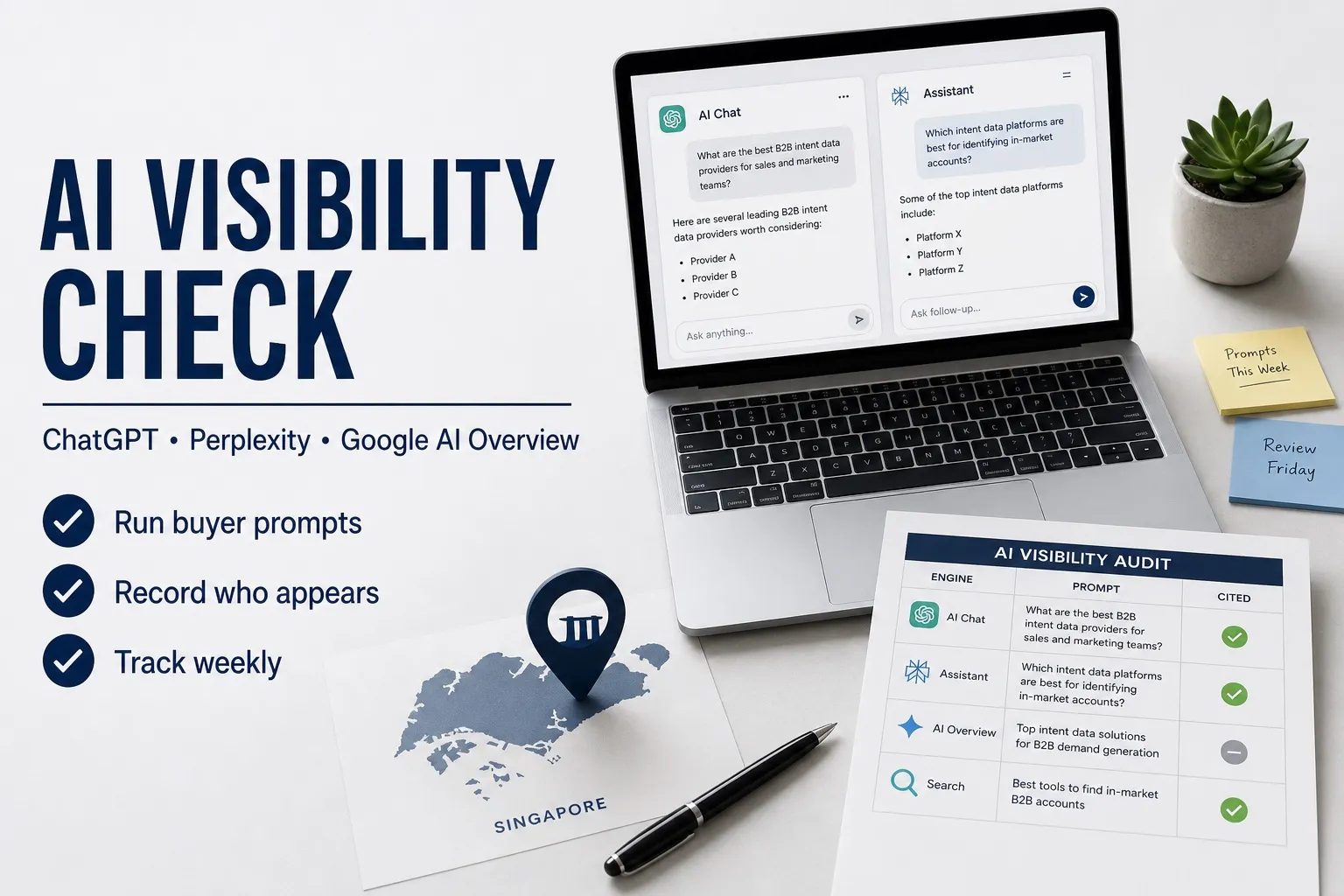
How to check if your Singapore company appears in ChatGPT and Perplexity
Step-by-step guide for Singapore B2B teams to test whether your company appears in ChatGPT, Perplexity, and Google AI Overview — and what to record.
To check whether your Singapore company appears in AI search, open ChatGPT, Perplexity, and Google AI Overview in an incognito browser with Singapore region set, run three to five buyer-style prompts your prospects would actually type — not your company name alone — and record whether your brand is named, which competitors appear instead, and which URLs each engine cites. Repeat weekly to track changes.
The surfaces to test
Singapore B2B buyers now research software across four AI-powered surfaces. Each draws from a different source pool and returns different shortlists for the same question.
ChatGPT (OpenAI) generates conversational answers from its training data and browsing capabilities. It often names vendors directly but may not show citation links. Buyers use it for category discovery and vendor shortlisting.
Perplexity is an AI search engine that answers questions with inline numbered citations — links to the web pages it used. Perplexity tends to cite third-party comparison articles, government pages, and review sites rather than vendor homepages alone.
Google AI Overview appears at the top of Google search results for many queries. It synthesises an answer from Google’s search index — a different pool from ChatGPT or Perplexity. A company can appear here and be absent from conversational AI, or vice versa.
Claude (Anthropic) is a fourth surface worth testing if your buyers use it. Citable includes Claude in weekly index tracking because its shortlists differ from ChatGPT and Perplexity on the same prompt.
Testing one engine is not enough. Citable’s visibility research found that only 1 in 12 Singapore payroll vendors appeared on all four engines in a June 2026 baseline run.
What prompts should you use to test your company?
Do not search your company name. Branded queries tell you almost nothing about category visibility — buyers form shortlists before they know your brand exists.
Write prompts the way your buyers ask questions:
- Name the role (“I’m an HR director in Singapore…”)
- Name the requirement (“…for CPF, SDL, and IRAS compliance”)
- Ask for a shortlist, not a yes/no (“Which platforms should I evaluate?”)
Good prompt examples:
I’m an HR director in Singapore. Which payroll software platforms should I shortlist for CPF, SDL, and IRAS compliance?
I’m a CFO at a Singapore company paying suppliers in Malaysia and Indonesia. Which cross-border payment platform should I use?
Which corporate card platform do Singapore startups use for team expenses?
Bad prompt examples:
Is [YourCompany] good?
[YourCompany] reviews
Tell me about [YourCompany]
Run three to five category prompts per session. If you operate in multiple markets, add a geography variant — buyers in Malaysia and Indonesia research differently than Singapore-only prompts capture.
How do you run a visibility check in ChatGPT?
- Open an incognito or private browser window. Log out of any ChatGPT account if possible — logged-in sessions may personalise results.
- Go to chat.openai.com and start a new conversation.
- Paste your buyer prompt exactly. Do not add your company name.
- Read the full response. Note every brand named in the answer.
- Check whether your company appears. If yes, note the context (recommended, mentioned in passing, listed fifth).
- If ChatGPT cites URLs, copy them. If not, record “no citations shown.”
- Screenshot or copy the full response text into your audit log.
- Wait two to three minutes, then repeat with the next prompt in a new conversation.
ChatGPT answers vary between sessions. A single run is a snapshot, not a definitive score. For a confirmed signal, run the same prompt three times and take the majority result (2 of 3).
How do you run a visibility check in Perplexity?
- Open Perplexity in an incognito window at perplexity.ai.
- Paste the same buyer prompt you used in ChatGPT.
- Read the answer and note every brand named.
- Scroll to the citation list beneath the answer. Perplexity shows numbered source links — copy every URL.
- Check whether your company is named in the response text.
- Check whether your website URL appears in the citations — being cited as a source is different from being recommended in the answer, but both matter.
- Record which competitors are cited and what type of source they come from (vendor homepage, comparison article, government page, review site).
- Copy the full response and all citation URLs into your audit log.
Perplexity’s citation list is the most actionable data in a manual audit. It tells you exactly which pages the engine trusts for your category — and whether your content is in that pool.
Should you test Google AI Overview separately?
Yes. Google AI Overview is not the same as ranking on page 1.
- Open Google in an incognito window with Singapore region (google.com.sg).
- Search a keyword-style query your buyers use — for example,
payroll software singapore smerather than a full conversational prompt. - Look for the AI Overview box at the top of results. Note which brands it names.
- Scroll to page 1 organic results (blue links). Note whether your company appears there too.
- Record both surfaces separately — AI Overview and organic listings can disagree.
In Citable’s Swingvy audit, the company appeared in Google AI Overview but not in page 1 organic results, and not in ChatGPT or Perplexity on the same buyer prompt. That fragmentation is common — documented in our visibility research.
What should you record in your audit log?
Use a spreadsheet with one row per engine-prompt combination. Minimum columns:
| Column | What to record |
|---|---|
| Date | Date of the check |
| Engine | ChatGPT / Perplexity / Google AIO / Claude |
| Prompt | Exact text you typed |
| Your company named? | Yes / No |
| Position | First named, listed, mentioned in passing, or absent |
| Competitors named | Every other brand in the response |
| URLs cited | All source links (especially from Perplexity) |
| Citation type | Vendor page / comparison article / government / review site |
| Notes | Anything unusual — sponsored labels, outdated info, wrong geography |
This is the same structure Citable uses in the Singapore Payroll AI Visibility Index. The baseline matrix scores each vendor 0 or 1 per engine; your internal log can use the same yes/no scoring.
How do you interpret the results?
After one session across three engines and three prompts, you will fall into one of three patterns:
Visible everywhere. Your company is named on most engines for most prompts. You have baseline category visibility — but still check which competitors appear alongside you and whether the context is accurate.
Visible on one surface only. You appear in Google AI Overview but not ChatGPT, or in Perplexity but not Claude. This is the most common pattern for Singapore B2B companies Citable has audited. Buyers who use the engine where you are absent never see you.
Absent everywhere. No engine names your company on category prompts. Competitors and third-party publishers appear instead. This is the visibility gap — not a ranking problem, but a discoverability problem at the point where shortlists form.
None of these outcomes are permanent. AI engine shortlists shift as new content gets published and cited. That is why a one-time check is a starting point, not a final answer.
Comparison table: what each engine returns
Based on Citable’s June 2026 audit data for Singapore payroll buyer prompts:
| Engine | Shows citations? | Typical sources cited | Shortlist size | Agrees with other engines? |
|---|---|---|---|---|
| ChatGPT | Sometimes | Vendor .sg homepages, product pages |
4–6 vendors | Partial overlap with Perplexity and Claude |
| Perplexity | Always (numbered links) | IRAS/MOM pages, HR listicles, vendor pages | 2–4 vendors | Often differs from ChatGPT and Google |
| Google AI Overview | Links to search results | Google index — vendor sites, listicles, directories | 5–8 vendors | Often differs from conversational AI |
| Claude | Sometimes | Third-party reviews, vendor pages, listicles | 4–6 vendors | Partial overlap with ChatGPT |
Only 8% of tracked vendors appeared on all four engines in the baseline run. Testing one surface gives an incomplete picture.
What to do after your first check
- Share results with your team. Marketing, sales, and product should see the same baseline — especially which competitors AI engines recommend instead of you.
- Identify citation gaps. If Perplexity cites comparison articles that name your competitors but not you, the fix is authority content — not homepage SEO alone.
- Set a weekly cadence. Re-run the same locked prompts every week. Track movement, not just presence.
- Expand prompts over time. Add decision-stage questions (“How does [Competitor] compare to [Competitor] for Singapore SMEs?”) once category prompts are baselined.
If you want Citable to run and interpret this across your category — including competitor mapping and citation source analysis — request a free AI visibility audit.
For a worked example of what fragmented visibility looks like in practice, read Why Singapore B2B companies are invisible in AI search. For a category-specific buyer guide structured to earn AI citations, see Best payroll software for Singapore SMEs.
Sources and methodology
Steps reflect Citable's locked audit protocol used in Singapore B2B visibility research (June–July 2026): incognito browser, Singapore region, buyer-style prompts, one run per engine per session. Manual checks are snapshots; weekly repetition is recommended for trend detection.
Citable audit data (primary)
- Citable visibility audit protocol — Swingvy payroll test, 26 June 2026
Observed in AI engine responses
Listed for transparency; Citable does not endorse third-party content.
- OpenAI — ChatGPT (retrieved 16 July 2026)
- Perplexity — AI search (retrieved 16 July 2026)
- Google — Search (Singapore) (retrieved 16 July 2026)
Policy and third-party references
- Why Singapore B2B companies are invisible in AI search (Citable visibility research) (retrieved 16 July 2026)
- Singapore Payroll AI Visibility Index — baseline methodology (Citable research) (retrieved 16 July 2026)
- How B2B buyers in Singapore, Malaysia, and Indonesia research software (Citable SEA Market research) (retrieved 16 July 2026)
Frequently asked questions
- How do I check if my Singapore company appears in ChatGPT?
- Open ChatGPT in an incognito browser window, set your location to Singapore if prompted, and type a buyer-style prompt your prospects would use — for example, "Which payroll software should a Singapore SME shortlist for CPF and IRAS compliance?" Do not search your company name alone. Read the full response and note whether your brand is named, which competitors appear, and whether any URLs are cited. Repeat with two to three related prompts.
- How is checking Perplexity different from checking ChatGPT?
- Perplexity shows inline citations beneath its answer — numbered links to the sources it used. Copy both the response text and every cited URL separately. ChatGPT may name vendors without citing sources, or cite vendor homepages directly. The two engines draw from different source pools, so your company can appear in one and be absent from the other.
- Should I also test Google AI Overview?
- Yes. Google AI Overview is a separate surface from ChatGPT and Perplexity — it pulls from Google's search index, not the same training or retrieval pools. A company can appear in Google's AI summary yet be absent from ChatGPT on the same category prompt. Search your buyer query in Google (Singapore, incognito) and check both the AI Overview box and the page 1 organic results.
- What prompts should I use for an AI visibility check?
- Use the exact questions your buyers type when researching your category — not branded searches. Good prompts name the role, geography, and requirement: "I'm a CFO in Singapore. Which cross-border payment platform should I use for ASEAN supplier payouts?" Bad prompts are too narrow: "Is [YourCompany] good?" Category prompts reveal whether AI engines recommend you at the discovery stage, where most B2B shortlists form.
- How often should I run an AI visibility audit?
- Run a baseline once, then repeat weekly at minimum. AI engine shortlists shift as new content gets indexed and cited. Citable's Singapore Payroll AI Visibility Index tracks the same locked prompt every week and publishes delta reports — that cadence catches movement that a one-time check misses.
- What does it mean if my company appears in Google but not ChatGPT?
- It means your visibility is fragmented across surfaces — a pattern Citable documented when auditing Singapore B2B SaaS companies. Google AI Overview and conversational AI use different source pools. Appearing in one does not guarantee presence in the other. Buyers who research in ChatGPT or Perplexity may never see you, even if you rank on Google.
- Do I need a paid tool to check AI visibility?
- No. A manual audit in incognito browsers takes 30 to 45 minutes for three engines and three prompts. Record results in a spreadsheet: engine, prompt, date, brands named, URLs cited, and a yes/no for your company. Paid tools and API-based checkers automate this at scale, but the manual protocol is enough for a first baseline.
More B2B visibility guides
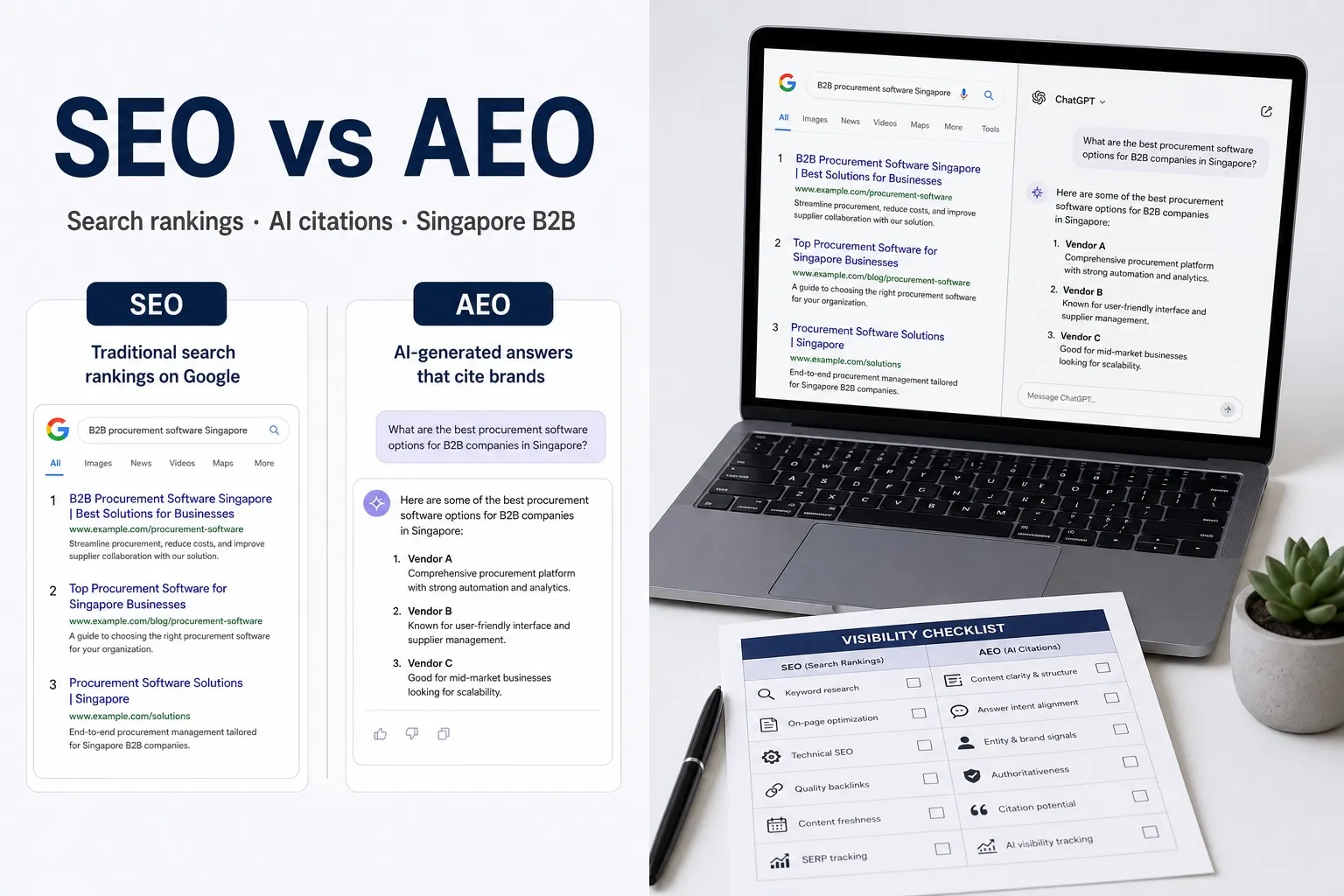
What is AEO and how is it different from SEO — a guide for Singapore B2B marketers
What is AEO, GEO, and how do they differ from SEO? A practical explainer for Singapore B2B marketing teams building visibility in AI search.
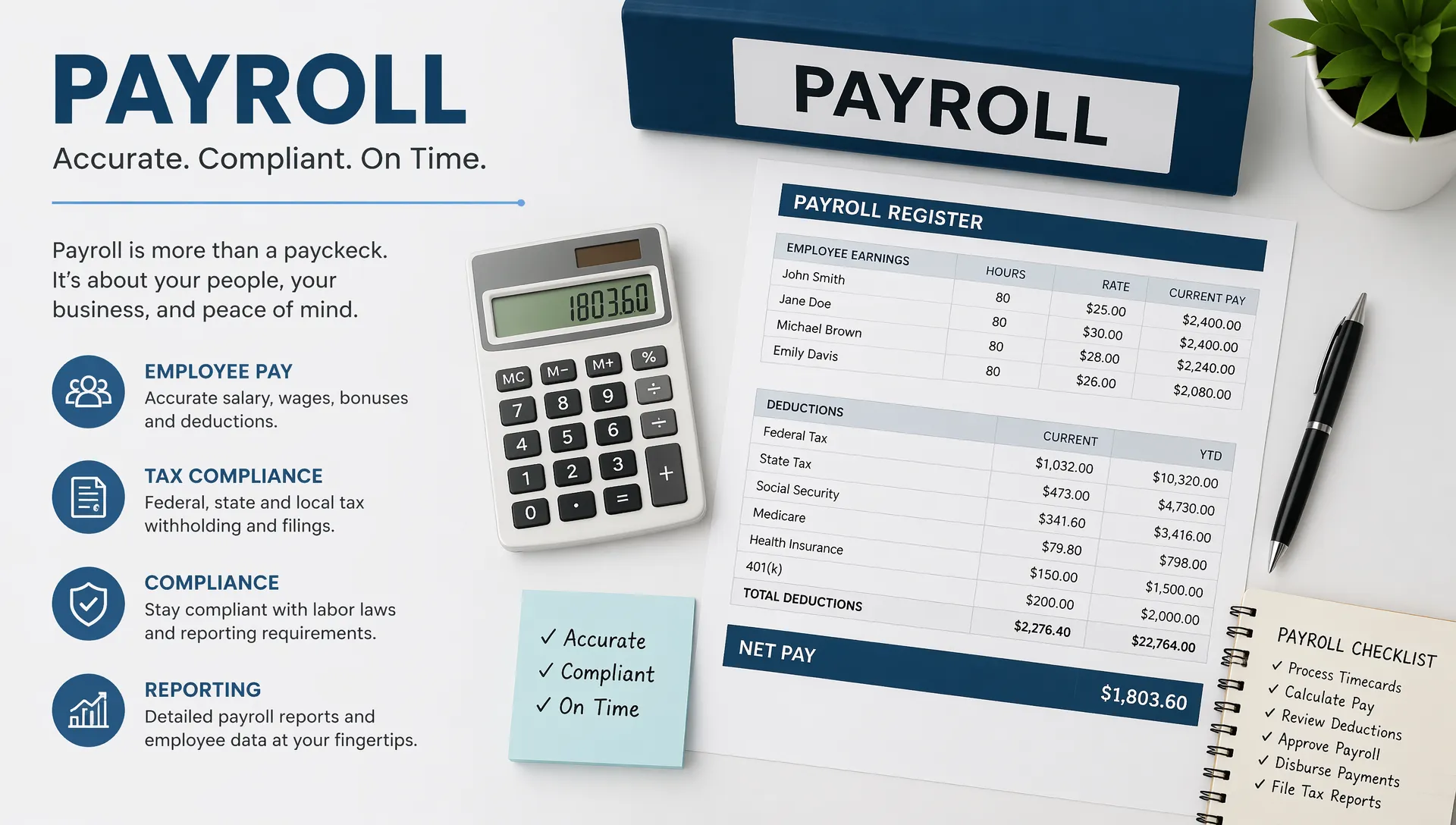
Best payroll software for Singapore SMEs — 2026 comparison
A factual comparison of payroll software for Singapore SMEs — CPF, SDL, IRAS filing, pricing, and which platforms AI search engines recommend in 2026.